

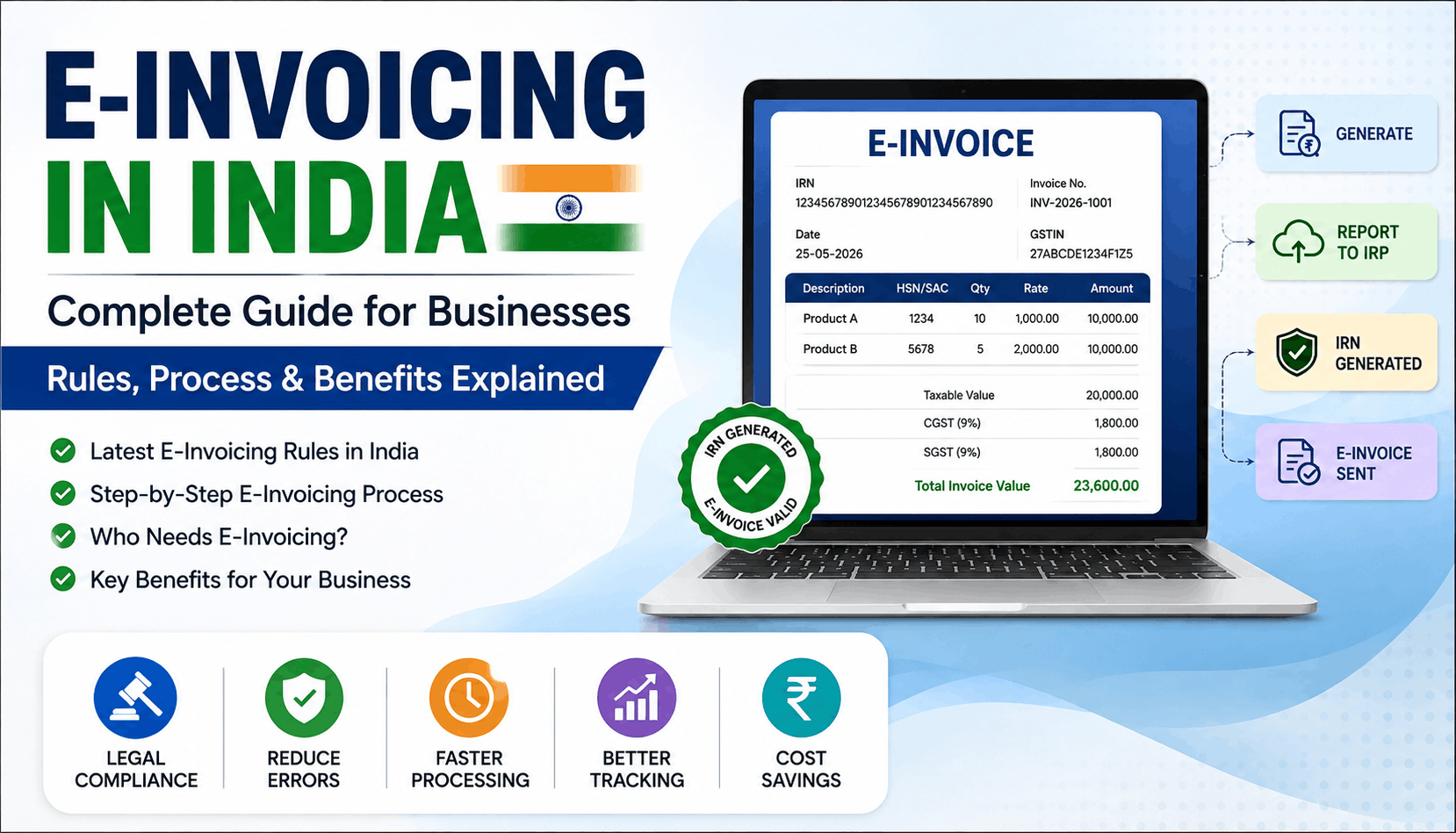
For many businesses, GST compliance already feels like a full-time task. Add invoice matching, reporting deadlines, and manual data entry into the mix, and mistakes become almost unavoidable. That’s one reason why the government introduced electronic invoicing under GST.
If you run a business that falls under the prescribed turnover limits, understanding the e-invoicing system is no longer optional. Delays or incorrect invoices can directly affect GST filing, input tax credit, and even customer relationships.
This guide explains how e-invoicing works, who needs to comply, the step-by-step process, and the practical benefits businesses actually experience after implementation.
What is E-Invoicing Under GST?
E-invoicing is a system where B2B invoices are electronically authenticated through the government’s Invoice Registration Portal (IRP).
Contrary to what many people assume, businesses do not create invoices on a government portal. You still generate invoices using your accounting or billing software. The invoice data is then uploaded to the IRP for validation.
Once approved, the portal generates:
- Invoice Reference Number (IRN)
- QR code
- Digital authentication
Only after this validation does the invoice become a valid GST invoice for applicable businesses.
That’s the basic structure of E-Invoicing India today.
Who Needs to Follow E-Invoicing Rules?
The applicability of e-invoicing depends on annual turnover limits notified by the GST department.
Currently, businesses crossing the prescribed turnover threshold in any financial year from 2017-18 onward must comply with e-invoicing requirements.
Typically, e-invoicing applies to:
- B2B invoices
- Export invoices
- Debit notes
- Credit notes
It generally does not apply to:
- B2C invoices
- SEZ units in some cases
- Certain exempt sectors like banking and insurance
Most growing businesses ignore one important detail here. Even if your current turnover drops below the threshold later, e-invoicing may still remain applicable because eligibility is checked based on previous financial years as well.
That’s where many compliance mistakes happen.
How the E-Invoicing Process Works
The process itself is not very complicated once your software setup is correct.
Step 1: Create Invoice in Accounting Software
The business generates an invoice through ERP or GST billing software.
The invoice must contain mandatory GST fields such as:
- GSTIN
- Invoice number
- Invoice date
- HSN code
- Tax details
- Buyer information
Step 2: Upload Invoice Data to IRP
The invoice details are uploaded to the Invoice Registration Portal.
This can happen:
- Directly through integrated software
- Via APIs
- Through JSON upload
Businesses handling high invoice volumes usually automate this step entirely.
Step 3: IRN Generation
The IRP validates the invoice details and generates:
- Unique Invoice Reference Number
- QR code
- Digital signature
Once validated, the invoice becomes officially registered.
Step 4: GST System Update
The invoice data is automatically shared with:
- GST portal
- E-way bill system (where applicable)
This reduces duplicate data entry significantly.
In practical terms, businesses spend less time manually preparing GSTR reports because much of the data already flows into the system.
Common Problems Businesses Face With E-Invoicing
The real issue is not generating invoices. It’s handling errors at scale.
Here are some common problems businesses deal with during implementation:
Incorrect GSTIN or HSN Codes
Even small data mismatches can lead to invoice rejection.
Duplicate Invoice Numbers
The IRP does not allow duplicate invoice uploads for the same financial year.
Manual Entry Errors
Businesses still relying heavily on Excel often struggle with validation failures.
Integration Issues
Older accounting software may not support proper GST e-invoicing workflows.
Most people ignore this part. The software setup matters more than the actual invoice generation.
A good GST billing software can automatically validate fields before upload and reduce rejection rates considerably.
Benefits of E-Invoicing for Businesses
Initially, many businesses viewed e-invoicing as just another compliance burden. But over time, several operational advantages became clear.
Faster GST Compliance
Since invoice data flows directly into GST returns, filing becomes easier and more accurate.
Reduced Manual Work
Data entry duplication reduces significantly.
Teams no longer need to repeatedly enter invoice details for:
- GST returns
- E-way bills
- Reconciliation
Better Accuracy
Automated validation reduces invoice mismatches and calculation errors.
Improved Input Tax Credit Matching
Buyers receive properly reported invoices faster, helping avoid ITC disputes later.
Easier Audit Tracking
Digitally authenticated invoices create a clearer audit trail.
For businesses handling hundreds of invoices monthly, this saves substantial time during GST scrutiny or internal audits.
E-Invoicing and E-Way Bill Connection
One useful advantage of the electronic invoicing system is its integration with e-way bill generation.
If invoice details are correctly uploaded, part of the e-way bill information gets auto-populated.
This helps businesses:
- Save processing time
- Reduce duplicate entry mistakes
- Improve dispatch efficiency
That’s especially useful for wholesalers, manufacturers, and transport-heavy businesses.
Practical Tips Before Implementing E-Invoicing
Businesses that transition smoothly usually focus on preparation first.
Here’s what actually matters:
Choose Compatible Accounting Software
Your software should support:
- IRN generation
- QR code printing
- GST return integration
- JSON/API support
Clean Existing Data
Check:
- GSTIN formats
- Customer masters
- HSN codes
- Tax settings
Train Billing Staff
Most invoice failures happen because teams are unfamiliar with validation rules.
Automate Where Possible
Businesses with high invoice volumes benefit greatly from automation instead of manual uploads.
A proper GST invoicing software setup reduces both compliance pressure and operational confusion.
Key Takeaways
E-invoicing India is gradually becoming a standard part of GST compliance for Indian businesses. While the initial setup may feel technical, the long-term benefits are practical and measurable.
Businesses that implement the system properly usually experience:
- Faster invoice processing
- Better GST accuracy
- Reduced manual work
- Easier reconciliation
- Fewer filing errors
The goal is not just compliance anymore. Efficient invoicing directly impacts cash flow, reporting accuracy, and day-to-day operations.
Frequently Asked Questions
Common questions about e-invoicing rules, process, compliance, and verification in India.
E-invoicing is mandatory for GST-registered businesses whose aggregate annual turnover has exceeded ₹5 crore in any financial year from 2017–18 onwards, subject to applicable GST rules and exemptions.
No. You can generate invoices using your regular accounting or ERP software. The software then sends the required invoice data to the Invoice Registration Portal (IRP), where the invoice is validated and an Invoice Reference Number (IRN) is generated.
If e-invoicing becomes applicable to your business based on the prescribed turnover criteria, you should continue complying with the applicable e-invoicing requirements. The exact applicability should be checked against the latest GST notifications and your business’s specific circumstances.
Once the IRP validates the invoice and generates the IRN and QR code, you can provide the signed e-invoice to your customer through your normal business process, such as printing it or sending the invoice electronically.
No. An e-invoice cannot be edited after an IRN has been generated. If an error is identified, the applicable process is to cancel the e-invoice within the permitted cancellation period and issue a fresh invoice with the correct details and a new IRN.
The mandatory e-invoicing framework primarily covers specified transactions such as B2B supplies, exports, and supplies to SEZ units, subject to applicable rules and exemptions. Ordinary B2C transactions are generally not covered by the same mandatory e-invoicing requirement.
Failure to generate a required e-invoice can result in penalties under GST law, including a penalty of ₹10,000 or the applicable tax involved, subject to the specific statutory provisions and circumstances. There can also be consequences for the validity of the invoice and the recipient’s ability to claim Input Tax Credit (ITC).
Businesses can access the official e-invoice services through the GST e-invoice system and Invoice Registration Portal. Registration and authentication are completed using the applicable GST credentials and access process.
Yes, an e-invoice does not automatically replace the requirement for an E-Way Bill where an E-Way Bill is applicable. Depending on the system and transaction details, relevant transport information can be provided so that e-invoice and E-Way Bill processes can be integrated.
You can verify an e-invoice by scanning its QR code using the official GST e-Invoice QR Code Verifier or the applicable government verification facility. The verification process can display key invoice information and help confirm whether the e-invoice details are valid.