

Most small business owners I’ve spoken to treat inventory as a warehouse problem. Count the boxes, update the sheet, done. Accounting is a separate thing – invoices, GST, P&L. Two different worlds.
That gap? It’s costing them money. Silently, consistently.
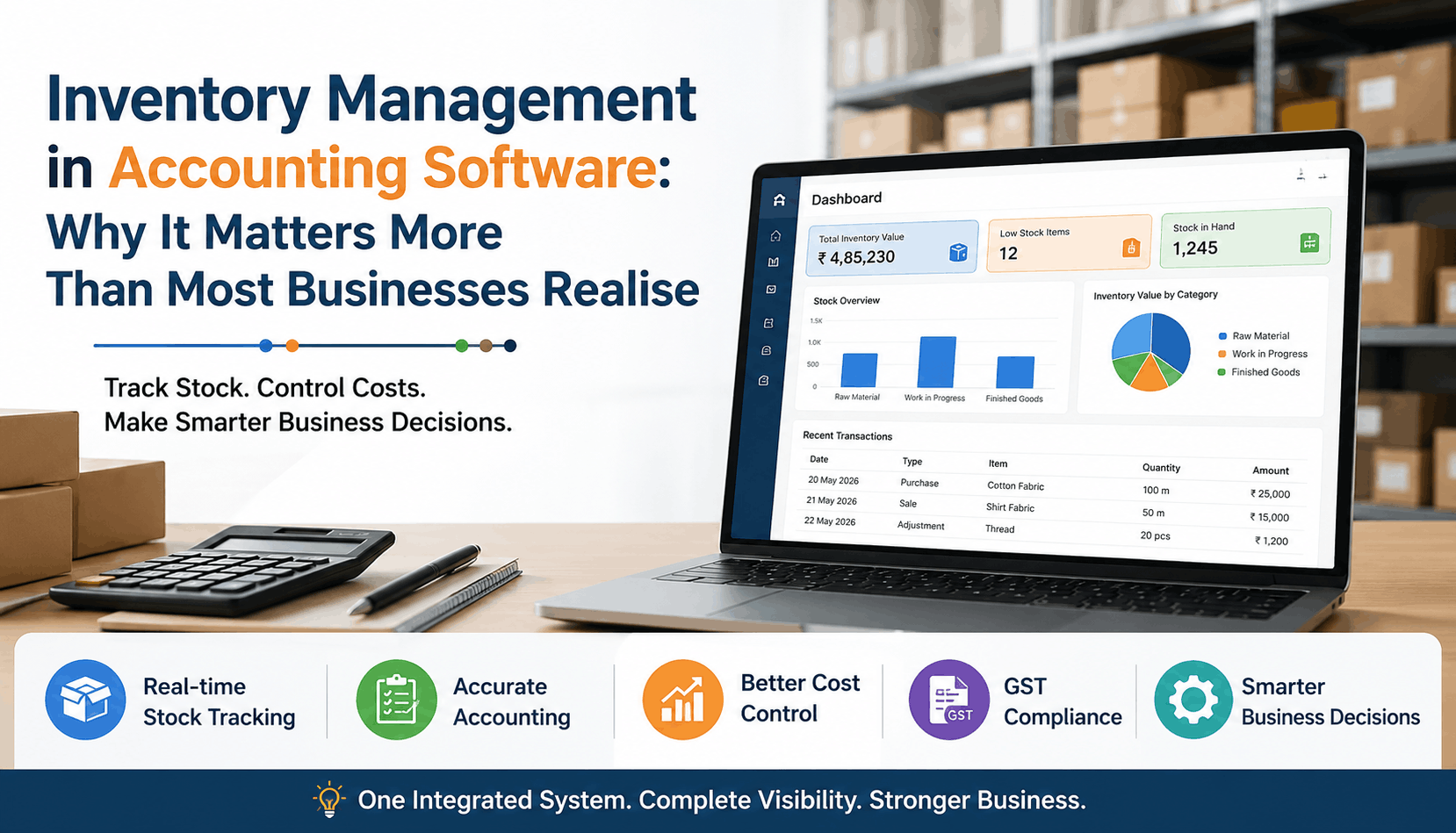
The moment you start using inventory management accounting software that actually connects both sides, you stop flying blind. Stock levels, purchase costs, sales margins – it all reflects in one place, in real time. No more end-of-month reconciliation panic. No more finding out your COGS was wrong after you’ve already filed.
The Actual Problem With Doing It Manually
Let’s say you run a trading business. You’ve got 200-odd SKUs moving in and out every week. Your team updates stock in Excel. Your accountant pulls invoices from a different folder. Neither of them is talking to the other system.
Now a customer places a big order. Someone checks the sheet – yes, stock available. Order confirmed. Turns out, half of it was already committed to another buyer two days ago and nobody updated the file. You either delay the customer or scramble for emergency stock at a worse price.
That’s not a hypothetical. That’s Tuesday for a lot of businesses operating without proper inventory management accounting software.
The financial damage isn’t always dramatic. Sometimes it’s ₹15,000 in a write-off here. A missed reorder there. A wrong stock valuation that throws off your balance sheet. Over a year, it adds up to a number most owners would be uncomfortable seeing.
Where Accounting and Inventory Actually Overlap
Most people ignore this part.
When you sell something, three things happen financially: your revenue goes up, your stock value goes down, and your cost of goods sold changes. If your accounting software doesn’t know what left the warehouse, those three numbers don’t stay in sync.
Inventory management accounting software handles this automatically. Every outward movement updates the books. Every purchase entry adjusts your stock valuation. You don’t need to tell it twice.
For Indian businesses specifically, this matters even more. Your GST filings depend on accurate purchase and sales data. If your stock records don’t match your invoices, your GSTR2B reconciliation turns into a nightmare. We’re talking hours of manual cross-checking that could’ve been avoided entirely.
What Actually Changes When You Use the Right Software
Stock Doesn’t Disappear Mysteriously Anymore
Ghost inventory is a real thing – items that show as “in stock” on paper but are physically missing, damaged, or expired. Without a proper stock tracking system, you won’t catch this until it’s too late. Integrated software flags discrepancies early, before they hit your financials.
You Stop Over-Ordering (and Under-Ordering)
Both are expensive. Overstocking locks up working capital. Stockouts lose you sales and sometimes customers permanently. Reorder point alerts in good inventory control software solve both – not perfectly, but significantly better than gut feeling.
Your Accountant Actually Has Accurate Numbers
This sounds basic. But when your purchase entries, stock levels, and sales invoices all live in the same system, your accountant isn’t spending half their time cleaning up data. The P&L is reflecting reality, not last week’s reality.
Expiry and Batch Tracking Stops Being a Guessing Game
If you’re in food, pharma, or any product with a shelf life, this one’s critical. A proper inventory management accounting software with batch tracking ensures older stock moves first. The alternative is writing off expired goods – which is a direct loss, no way around it.
A Quick Example Worth Knowing
A small manufacturer was struggling with raw material costs that never seemed to match projections. Every quarter, the actual cost of production was higher than estimated – but nobody could pinpoint why.
Turned out, material consumption wasn’t being tracked at the batch level. Workers were pulling more than required, and nobody noticed because the stock sheet wasn’t granular enough. After switching to a stock management system built into their accounting software, consumption got logged against each production batch. Within two months, material wastage dropped noticeably. The savings covered the software cost in the first quarter.
That’s the kind of outcome that doesn’t show up in a feature list, but happens in practice.
What to Look For (Without Overcomplicating It)
You don’t need software with a hundred features you’ll never use. You need:
- Stock that updates automatically when you raise an invoice
- GST-compliant purchase and sales entries
- Low stock alerts you can actually configure
- Multi-location support if you have more than one godown
- Decent reporting – stock valuation, movement history, slow-moving items
If the inventory and accounting modules feel like two separate tools duct-taped together, they probably are. That integration quality matters more than anything else on the features page.
Things Worth Keeping in Mind
- Disconnected stock and accounting is where most small business losses hide
- Real-time inventory data prevents both overstocking and stockouts
- Accurate COGS means your margins and tax filings are actually trustworthy
- Inventory management accounting software isn’t just a convenience – for growing businesses, it’s damage control
- The right stock management system reduces manual work and the errors that come with it
Frequently Asked Questions
Common questions about inventory management, accounting software, stock control and business operations.