

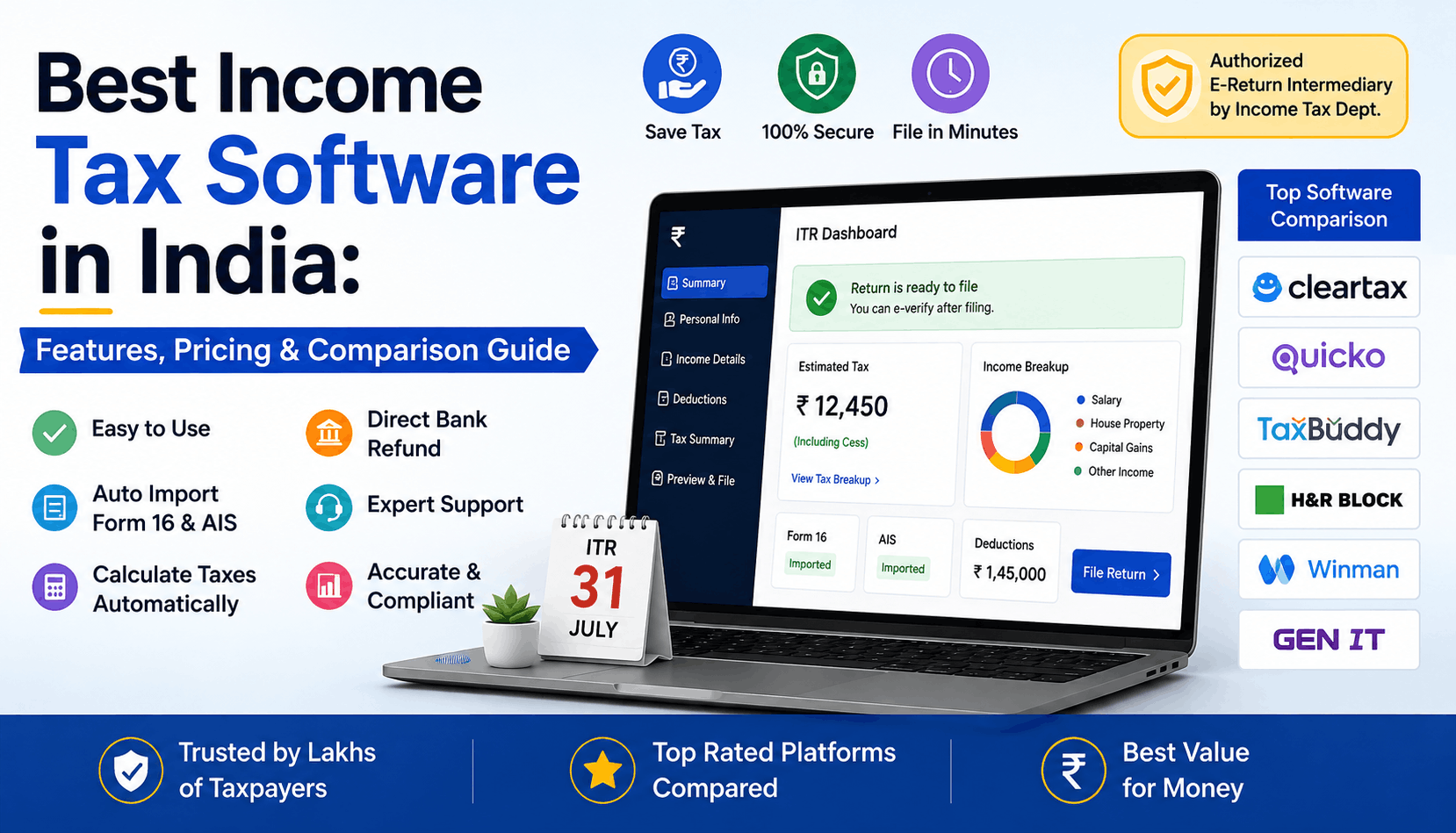
Let’s be honest – nobody enjoys filing their income tax return. It’s one of those tasks that always feels more complicated than it should be, and every year there’s something new to deal with. A new section, a changed deadline, or that one form that doesn’t seem to match your Form 26AS no matter what you do.
I’ve talked to enough people who’ve filed late, paid interest they didn’t need to, or missed deductions simply because they were doing everything manually or relying on a CA who was handling 500 other clients at the same time. The fix, in most cases, is simpler than people think – pick the right income tax return filing software and actually use it before July 30th.
But which one? That’s where it gets messy.
The Problem With Most “Best Software” Lists
Search for “best income tax software in India” and you’ll find the same five names recycled across every blog. Most of those lists were written by people who haven’t actually used these tools. They copy pricing pages, rearrange bullet points, and call it a comparison.
This one’s different. Here’s what actually matters when you’re picking ITR filing income tax software – what each platform handles well, where they fall short, and who they’re genuinely built for.
ClearTax – The Safe Default for Most People
ClearTax is probably the platform most Indians land on first when they start looking for income tax software. It’s been around long enough, the interface works, and the free plan covers ITR-1 which handles a large chunk of salaried filers.
For a straightforward return – one employer, standard deduction, maybe a home loan – the free plan does exactly what you need. Upload your Form 16, let it prefill the data from AIS and Form 26AS, cross-check the numbers, and file. Done in under 30 minutes if your documents are in order.
The paid plans start at around Rs. 500 and go up to Rs. 3,000 depending on how complicated your situation is. Capital gains, business income, multiple properties – these need the higher tiers. CA-assisted plans start at Rs. 1,499.
Where it works well: Salaried employees, people with simple investment income, small business owners who want guided income tax return filing.
Where it doesn’t: If you’re a trader with 200+ equity transactions or an NRI with foreign income, the experience gets clunky.
Quicko – Built for People Who Actually Trade
Here’s something most generic income tax software comparisons skip over – if you’ve done F&O trading or bought and sold mutual funds or stocks during the year, your capital gains calculation alone can take days if you’re doing it manually.
Quicko solves this in a way that ClearTax doesn’t quite match. It connects directly to Zerodha, Groww, Angel One, and several other brokers. Your trade data comes in automatically. LTCG, STCG, F&O P&L – it computes everything and maps it to the right fields in ITR-2 or ITR-3.
For basic ITR-1 it’s free. Trader plans start at Rs. 749 and go up to Rs. 2,999.
If you’ve traded even slightly during the year and you’re still doing this manually – stop. The ITR filing income tax software cost will pay for itself in the time you save, easily.
TaxBuddy – Worth Considering If Your Case Is Complex
TaxBuddy doesn’t get mentioned as often as it should. It’s particularly good for people who have income from multiple sources – freelance work plus salary, rental income, maybe some dividend income thrown in.
The deduction maximiser is the standout feature. It actually scans your profile and flags deductions you might have missed – sometimes Section 80D, sometimes HRA calculations people get wrong. It won’t find magic money, but it does catch the stuff people legitimately miss when they’re rushing.
Plans start at Rs. 599 for basic salaried returns. Complex cases with CA support go up to Rs. 4,999.
NRIs specifically seem to have a better experience on TaxBuddy than most other consumer platforms when it comes to income tax return filing. It handles the DTAA (Double Tax Avoidance Agreement) implications better than some competitors.
H&R Block India – For People Who Want Hand-Holding
Some people want software that explains what it’s asking and why. Not everyone knows what “rebate under Section 87A” means or why they’re being asked for their rent receipts. H&R Block’s approach is to walk you through each step with plain-language explanations.
It’s not the flashiest income tax software out there. But for a first-time filer, a salaried professional who just wants to be sure they’re not making mistakes, or someone who had a notice last year and is now extra cautious – it makes sense.
Pricing starts at Rs. 399. Expert-review plans go from Rs. 999 to Rs. 4,999. The expert review before submission is genuinely useful if you’ve got any doubt about your return.
Winman CA-ERP and Gen IT – These Are for CAs, Not Individuals
This needs to be said clearly because people sometimes get confused. Winman CA-ERP and Gen IT (by SAG Infotech) are professional ITR filing income tax software platforms built for Chartered Accountants and tax practitioners who are filing for dozens or hundreds of clients.
If you’re a CA firm, these are the tools you probably already know about. Bulk filing, tax audit reports (Form 3CB, 3CD), TDS returns, Form 15CA/15CB for foreign remittances – this is their territory.
Pricing is license-based. Winman runs roughly Rs. 8,000- Rs. 25,000+ per year depending on modules. Gen IT is in a similar range starting around Rs. 9,000.
For an individual filing their own return? These aren’t the right fit. The interface isn’t designed for self-filers and the learning curve doesn’t make sense for one return a year.
Side-by-Side: Which Income Tax Software for What
| Platform | Best Suited for | Free Plan | Paid Plans Start At |
|---|---|---|---|
| ClearTax | Salaried, SMBs | Yes (ITR-1) | Rs. 500 |
| Quicko | Traders, Investors | Yes (ITR-1) | Rs. 749 |
| TaxBuddy | Complex income, NRIs | No | Rs. 599 |
| H&R Block | First-timers, cautious filers | No | Rs. 399 |
| Winman CA-ERP | CA Firms | No | Rs. 8,000+ per year |
| Gen IT | Tax Professionals | No | Rs. 9,000+ per year |
A Few Things People Get Wrong When Choosing
Picking based on price alone. The cheapest income tax return filing software plan isn’t always the right one for your situation. Filing on the wrong ITR form or missing a required schedule can lead to a defective return notice – which costs more time and stress than the price difference.
Ignoring the AIS mismatch problem. Before you file using any income tax software, open your AIS on the income tax portal and cross-check it against what the software has pulled in. There are cases where interest income or dividend income shows up in AIS but doesn’t auto-populate correctly. That mismatch is your responsibility to fix.
Waiting till July 29th. Every major ITR filing income tax software platform has server issues and slow support in the last 72 hours before the deadline. It’s been like this for years. File by the 20th if you can.
Assuming the free plan covers everything. If you have capital gains – even just from redeeming mutual funds – you need ITR-2, not ITR-1. Most free plans don’t cover ITR-2. Check before you start.
Key Takeaways
- Simple salaried return with no capital gains → ClearTax or Quicko free plan is enough
- Active trader with broker transactions → Quicko, without question
- Multiple income sources, NRI status, or complex deductions → TaxBuddy paid plan
- First-time filer who wants guidance → H&R Block India
- CA managing 50+ clients → Winman or Gen IT
- Always verify your AIS data before submitting, regardless of which platform you use
- Don’t wait for the last week – the platforms get slow and support disappears
The right income tax software won’t just make filing faster. It reduces the actual risk of errors, catches deductions you’d otherwise miss, and means you’re not spending a Sunday in a panic because your return looks wrong and the CA isn’t picking up.
Frequently Asked Questions
Common questions about online ITR filing, tax software, broker integration, verification and tax refunds.