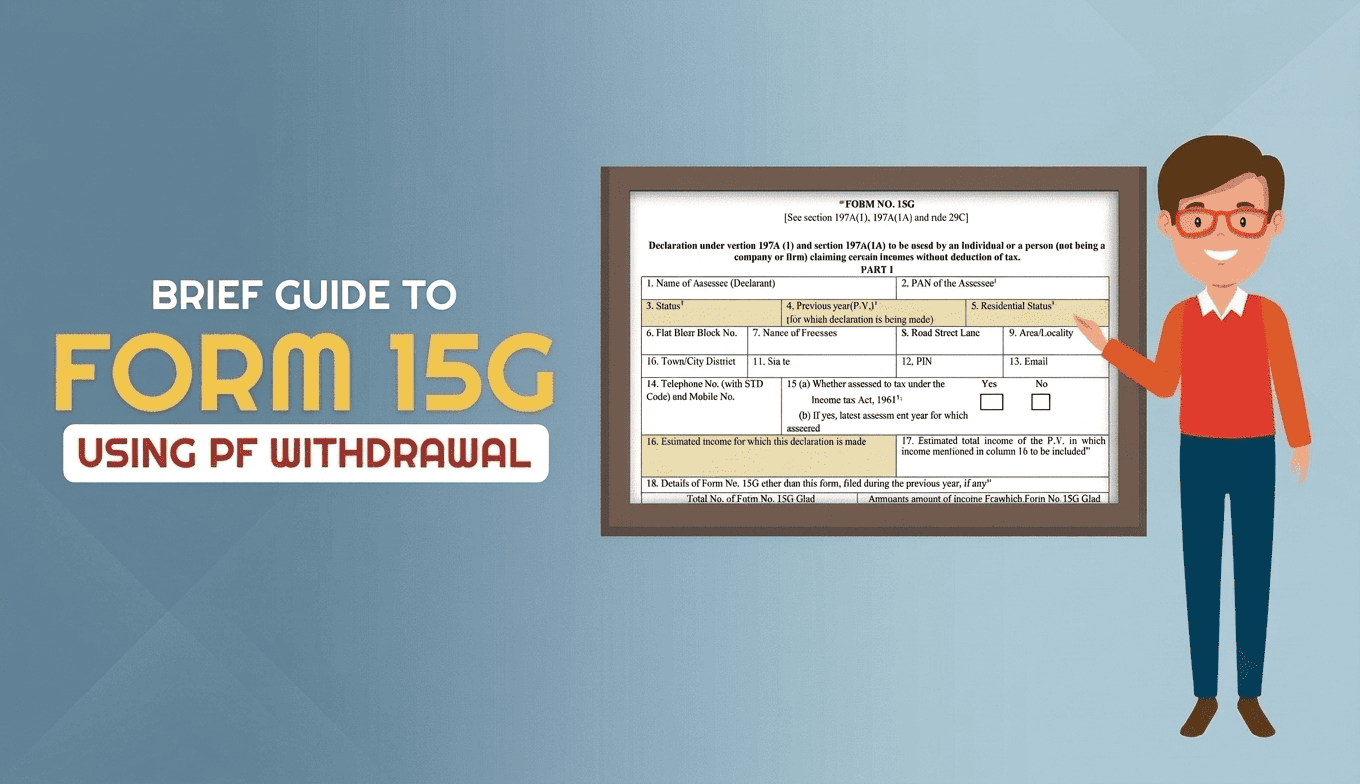
When withdrawing your Employees’ Provident Fund (EPF), you may face Tax Deducted at Source (TDS) if you have not completed five years of continuous service. Form 15G was used by eligible individuals to request withdrawal without TDS, provided they met the applicable income-tax conditions.
However, from Tax Year 2026-27, Form 121 replaces Forms 15G and 15H under the new income-tax framework. Understanding this change is essential before submitting a PF withdrawal claim.
What Is Form 15G for PF Withdrawal?
Form 15G was a self-declaration submitted by eligible taxpayers requesting that TDS not be deducted from specified income, including qualifying PF withdrawals.
It could be used when the estimated tax payable on the individual’s total income was nil and the prescribed eligibility conditions were satisfied.
Who Can Submit Form 15G for PF Withdrawal?
Under the earlier rules, Form 15G could generally be submitted by eligible resident individuals below 60 years of age, subject to the applicable income conditions.
PF withdrawals before five years of continuous service may attract TDS when the taxable withdrawal meets the prescribed threshold. Submitting a declaration does not automatically make an otherwise taxable withdrawal tax-free.
How to Fill the Declaration for PF Withdrawal
For Tax Year 2026-27 onwards, eligible taxpayers should refer to Form 121, the replacement for Forms 15G and 15H.
When completing the declaration, check the following details:
- Personal information: Enter your name, address, PAN and contact details accurately.
- Residential status: Confirm that you meet the applicable eligibility requirements.
- Tax year: Select the correct tax year for the declaration.
- Income details: Report the estimated income covered by the declaration and your estimated total income for the year.
- Previous declarations: Include details of other Form 121 declarations submitted during the same tax year, where applicable.
- Declaration: Review the information and confirm that the details provided are correct.
Submit the declaration to the relevant payer or follow the applicable EPFO claim procedure. Verify the current submission requirements before filing.
Example
Suppose an employee leaves a job after three years and plans to withdraw the accumulated PF balance. If the withdrawal is taxable and meets the applicable TDS threshold, tax may be deducted.
If the employee qualifies for the relevant nil TDS declaration, submitting the correct form may prevent TDS. The employee must still assess the withdrawal’s actual tax treatment.
Common Mistakes to Avoid
- Using an outdated form: Check whether Form 121 applies to your tax year.
- Providing incorrect income details: Calculate estimated total income carefully before making a declaration.
- Assuming no TDS means no tax: TDS and final tax liability are different.
- Ignoring service duration: Check your continuous service period before withdrawing PF.