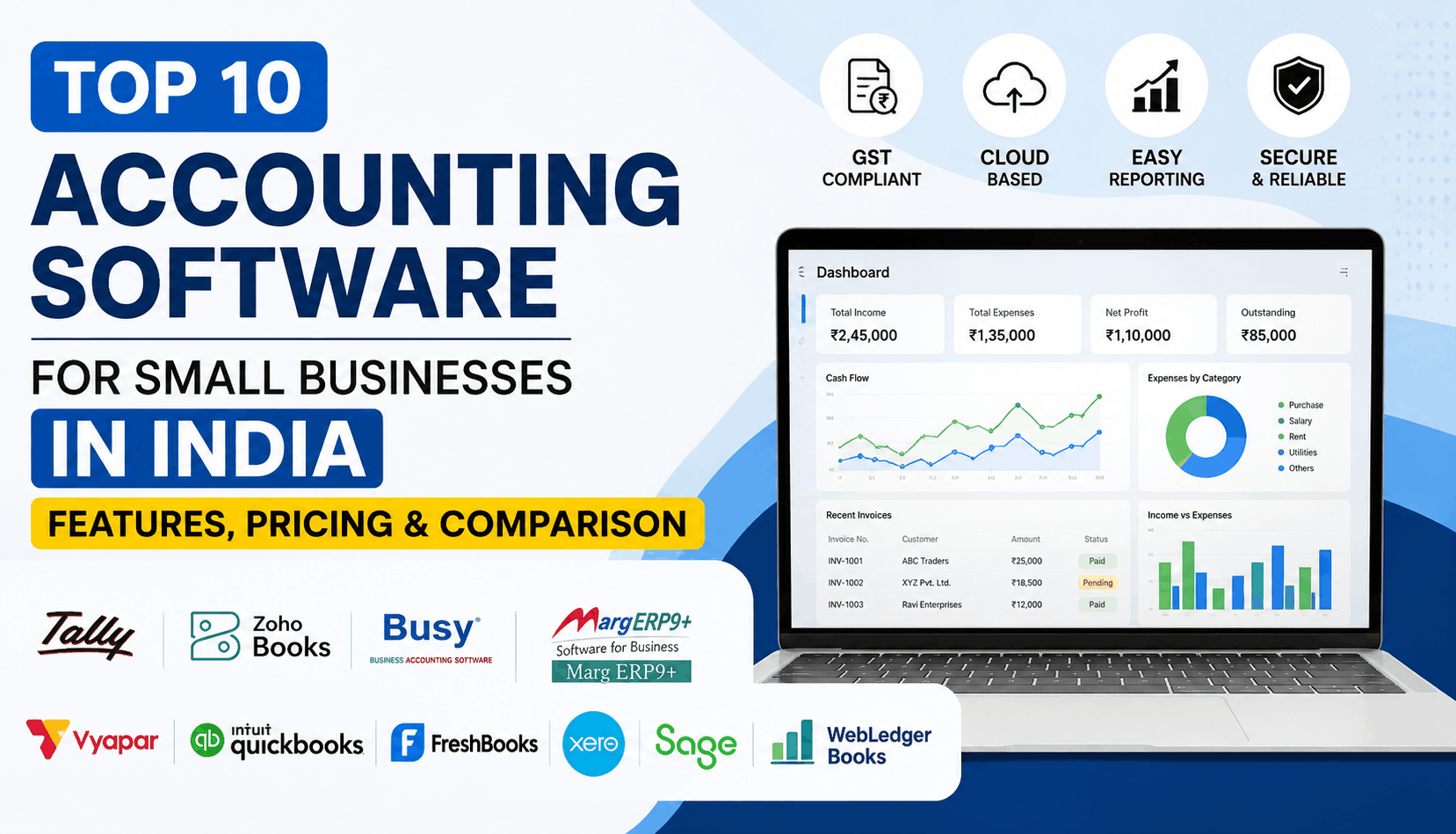
Running a small business in India already comes with enough moving parts – GST filings, invoices, inventory, vendor payments, bank reconciliation, and then the usual “Where did this expense go?” moments at month-end.
Most business owners start with Excel sheets or basic billing apps. That works for a while. But once transactions increase, things start slipping. Missing invoices, incorrect GST entries, delayed reports – it adds up quickly.
That’s usually the point where businesses start looking for proper accounting software.
Choosing the right Accounting Software Small Business India businesses can rely on is no longer just about bookkeeping.
The challenge? There are too many options. Some are built for accountants, some for large companies, and some look simple until you actually start using them.
This guide compares the best accounting software options for Indian small businesses based on features, pricing, ease of use, and practical usability.
What Small Businesses Should Actually Look For
Before comparing tools, here’s what genuinely matters for day-to-day operations.
1. GST Compliance
If the software makes GST filing complicated, it defeats the purpose. Look for:
- GSTR-1 reports
- E-invoicing support
- E-way bill generation
- GST reconciliation
2. Easy Invoice Management
Creating and sharing invoices quickly matters more than fancy dashboards.
3. Bank Reconciliation
Manual bank matching wastes hours every month. Most people ignore this part until errors start showing up.
4. Real-Time Reports
You should be able to check:
- Profit & Loss
- Outstanding payments
- Cash flow
- Inventory status
without depending on your accountant every single time.
5. Scalability
A software that works for 50 invoices may struggle with 5,000.
Here’s the comparison that actually helps.
1. Tally Solutions – Best for Traditional Accounting
Tally is still one of the most widely used accounting tools in India.
Key Features
- GST billing
- Inventory management
- Payroll
- Bank reconciliation
- Financial reporting
Pricing
Starts around Rs. 18,000 for a single license.
Best For
Businesses that are already familiar with desktop accounting systems.
Limitation
The interface feels outdated for many modern users.
2. Zoho Books – Best Cloud Accounting Option
Zoho Books is popular among startups and service businesses.
Key Features
- GST-compliant invoicing
- Automated workflows
- Client portal
- Mobile app
- Expense tracking
Pricing
Starts around Rs. 899/month.
Best For
Businesses wanting cloud-based accounting software with automation.
Limitation
Advanced inventory features may feel limited for trading businesses.
3. Busy Infotech – Best for Inventory Heavy Businesses
Busy works well for wholesalers, distributors, and stock-heavy businesses.
Key Features
- Inventory tracking
- GST filing
- Barcode support
- Multi-branch accounting
- Order processing
Pricing
Starts around Rs. 7,000- Rs.10,000 depending on version.
Best For
Retailers and distributors.
Limitation
The interface has a learning curve.
4. Marg ERP – Best for Pharma & Retail
Marg is heavily used in pharma and retail sectors.
Key Features
- Billing
- Inventory management
- GST reports
- Barcode integration
- Purchase management
Pricing
Starts around Rs. 9,000.
Best For
Medical stores and retail businesses.
5. Vyapar – Best for Mobile Billing
Vyapar became popular because it keeps things simple.
Key Features
- Billing app
- Inventory tracking
- GST invoices
- Payment reminders
- Mobile accessibility
Pricing
Starts around Rs. 3,999/year.
Best For
Small traders and local businesses.
Limitation
Reporting depth is lower compared to larger accounting platforms.
6. QuickBooks – Good for Simple Accounting
Although QuickBooks stopped major India operations, some businesses still use it.
Key Features
- Expense management
- Invoice tracking
- Reporting
- Cloud accounting
Best For
Freelancers and consultants with basic accounting needs.
Limitation
Limited India-focused GST ecosystem now.
7. FreshBooks – Best for Service Businesses
FreshBooks focuses more on invoicing and project billing.
Key Features
- Time tracking
- Invoice automation
- Expense management
- Client billing
Pricing
Starts around Rs. 600- Rs. 1,200/month.
Best For
Agencies, freelancers, and consultants.
8. Xero – Strong Reporting Features
Xero is globally popular and works well for businesses wanting modern reporting.
Key Features
- Financial dashboards
- Bank integration
- Expense management
- Payroll integrations
Best For
Businesses working internationally.
Limitation
Indian GST workflows are not as localized as Indian software.
9. Sage – Best for Growing Businesses
Sage works better once businesses become operationally larger.
Key Features
- Accounting
- Payroll
- Business reporting
- Compliance tools
Best For
Growing SMEs planning long-term scaling.
Limitation
Can feel expensive for smaller businesses.
10. WebLedger Books – Practical Choice for Indian SMEs
WebLedger Books focuses specifically on Indian businesses and CA-driven workflows.
Key Features
- GST reports & GSTR-1 filing
- E-invoicing & E-way bill generation
- Bank Excel import
- Real-time P&L and Balance Sheet
- Mobile app access
- Multi-business management
- GST reconciliation
Pricing
Starts around Rs. 2,999/year.
Best For
Businesses looking for practical GST accounting without overly complex setup.
What stands out is the balance between simplicity and compliance features. In practical terms, many businesses don’t need complicated ERP systems. They just need accounting software that saves time and reduces mistakes.
Quick Comparison Table
“`html id=”6qv8xa”
Compare starting prices and the businesses each accounting solution is best suited for.Top Accounting Software Comparison
Software
Starting Price
Best For
Tally
₹18,000
Traditional accounting
Zoho Books
₹8,999/month
Cloud accounting
Busy
₹7,000+
Inventory businesses
Marg ERP
₹9,000+
Pharma & retail
Vyapar
₹3,999/year
Mobile billing
QuickBooks
Varies
Freelancers
FreshBooks
₹600+/month
Service businesses
Xero
₹1,500+/month
International businesses
Sage
Higher pricing
Scaling SMEs
WebLedger Books
₹2,999/year
GST-focused SMEs
Which Accounting Software Should You Choose?
The real issue is that there’s no “best” software for everyone.
A wholesaler handling inventory has different needs compared to a consultant sending five invoices a month.
The best Accounting Software Small Business India businesses choose is usually the one that simplifies GST, invoicing, and reporting without creating extra complexity.
Here’s a simpler way to decide:
- Choose Tally if your accountant already works entirely on it.
- Choose Zoho Books if you want modern cloud accounting.
- Choose Busy if inventory is your biggest concern.
- Choose Vyapar for simple mobile billing.
- Choose WebLedger Books if GST workflows and practical business accounting are priorities.
The best is usually the one your team can actually use consistently without confusion.
That’s where things usually go wrong.
Frequently Asked Questions
Find answers to common questions about accounting software for Indian businesses.
Vyapar and WebLedger Books are on the lower end, starting around ₹3,000–₹4,000 a year. Tally and Sage sit at the higher end, especially once you factor in licensing and related costs.
If your accountant already works on Tally, switching may create more friction than it solves. However, businesses starting fresh may prefer newer cloud-based options because they offer more modern interfaces and remote accessibility, although Tally may involve a higher upfront investment.
Desktop accounting software such as Tally is installed on a computer and generally requires manual backups. Cloud accounting software such as Zoho Books or WebLedger Books runs online, allowing you and your accountant to access the same data from different locations without repeatedly exchanging files.
QuickBooks has scaled back its India operations, so its ecosystem is not as focused on Indian GST requirements as India-focused platforms. It can still work for freelancers and businesses with basic accounting needs, but businesses with significant Indian tax and compliance requirements may prefer a dedicated India-focused solution.
Busy and Marg ERP are designed for inventory-heavy businesses and offer features such as barcode support, stock management, and multi-branch workflows. Tools such as Vyapar or FreshBooks may be less suitable for businesses managing large inventory volumes.
Many India-focused accounting platforms, including Tally, Zoho Books, Busy, Vyapar, and WebLedger Books, provide GST-related features such as GSTR-1 support, e-invoicing, and e-way bill generation. International tools may not provide the same level of integration with Indian GST workflows.
Not necessarily. The right price depends on the features your business actually needs. A consultant billing a few clients each month does not need the same system as a distributor managing thousands of SKUs. Paying for features your team never uses can also increase unnecessary costs.
Check how the software performs at higher invoice volumes rather than judging it only from sample data. A platform that works smoothly with 50 invoices per month may perform differently at 5,000. Ask the vendor about performance, user limits, data capacity, and scalability before committing.
Yes. Accounting software can help with data entry, reconciliation, invoicing, and reporting, but a CA can provide professional judgment on tax strategy, compliance requirements, and financial advisory matters. Good software can also give your CA more time to focus on higher-value work.
GST compliance support, ease of use, reliability, and scalability should be among the top priorities. A system your team can use consistently is often more valuable than one with a long list of advanced features that are rarely used because the software is too complicated.