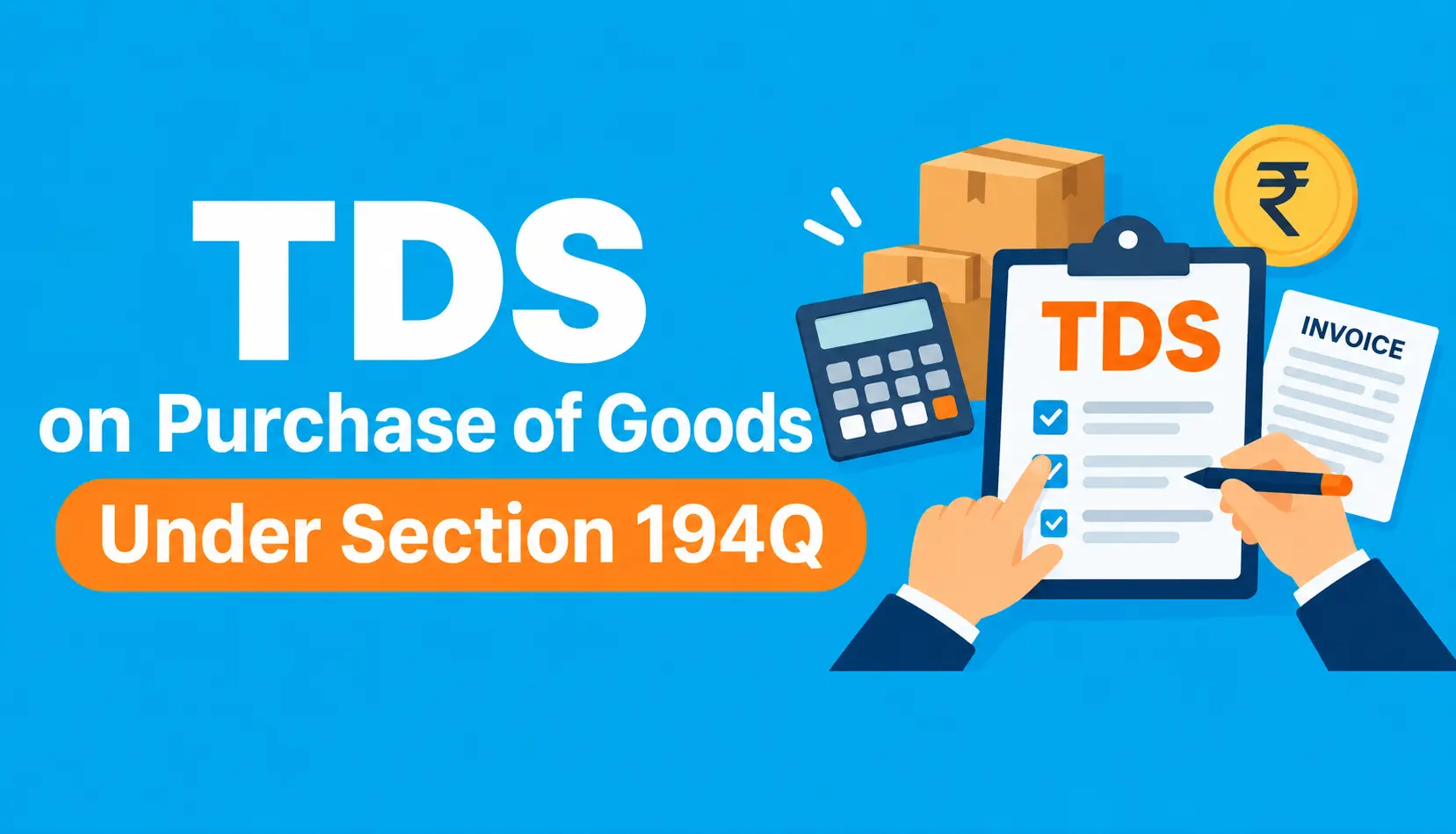
Say your business buys goods worth lakhs of rupees from a supplier. Before you pay, you may have to deduct Tax Deducted at Source (TDS). That rule sits in Section 194Q of the Income-tax Act, 1961, which was brought in to tighten tax compliance on high-value goods transactions.
If you run a business, trade, manufacture or handle finance for one, you need to get Section 194Q right. A wrong deduction can mean interest, penalties and a lot of extra work to fix it later.
Here’s a plain walkthrough of who has to deduct TDS, the threshold, how to calculate it, the exceptions and the mistakes people often make.
What Is Section 194Q TDS?
Section 194Q asks certain businesses to deduct TDS when they buy goods from a resident seller, provided the total purchases in a financial year go past Rs.50 lakh.
The TDS rate is 0.1%, and it applies only to the purchase amount above Rs.50 lakh.
This provision came into effect on 1 July 2021.
For transactions from 1 April 2026, the matching provision is Section 393(1), Table Serial No. 8(ii), of the Income-tax Act, 2025. The rate and threshold stay the same.
Who Is Required to Deduct TDS Under Section 194Q?
A buyer has to deduct TDS when all of these conditions are met:
- The buyer is carrying on a business.
- The buyer’s total sales, gross receipts or business turnover was more than Rs.10 crore in the immediately preceding financial year.
- The goods are bought from a resident seller.
- Total purchases from that seller go beyond Rs.50 lakh during the financial year.
Important: The Rs.10 crore turnover test is about the buyer. The Rs.50 lakh purchase threshold is worked out separately for each seller.
What Is the TDS Rate Under Section 194Q?
The rate is 0.1% on the purchase amount above Rs.50 lakh.
| Particulars | Details |
| TDS Rate | 0.10% |
| Purchase Threshold | Rs.50 lakh |
| Buyer’s Turnover | More than Rs.10 crore |
| Seller | Resident seller |
| Deduction Timing | Earlier of credit or payment |
If the seller doesn’t give a valid PAN, TDS can go up to 5% under the higher-rate provision.
How to Calculate TDS on Purchase of Goods?
You calculate TDS only on the amount above Rs.50 lakh. The full purchase value isn’t taxed.
Illustrative Example:
ABC Traders has an annual turnover of Rs.15 crore. In FY 2026-27, it buys goods worth Rs.80 lakh from XYZ Suppliers.
Calculation:
- Total purchases: Rs.80,00,000
- Threshold exemption: Rs.50,00,000
- Amount liable for TDS: Rs.30,00,000
- Applicable TDS rate: 0.1%
TDS = Rs.30,00,000 × 0.1% = Rs.3,000
So ABC Traders has to deduct Rs.3,000 as TDS.
When Should TDS Be Deducted?
TDS is deducted at whichever of these happens first:
- The purchase amount is credited to the seller’s account in your books.
- Payment is made to the seller, in any mode.
Advance payments follow the same rule. Suppose you pay a supplier in advance, before the purchase invoice is even recorded. Your TDS obligation can begin right then, at the time of the advance.
Does Section 194Q Apply to GST?
If GST is shown separately on the invoice and you deduct TDS when you credit the invoice, you can leave the GST out of the calculation.
But if you pay before the invoice is recorded, TDS is generally calculated on the whole payment. At that point, there’s no way to separate the GST component.
Keep your invoices and accounting records in order so you can apply this treatment correctly.
What Are the Exemptions Under Section 194Q?
Section 194Q doesn’t cover every purchase.
The main exclusions are:
- Purchases from non-resident sellers.
- Transactions where tax is deductible under another applicable provision.
- Transactions where tax is collectible under specified provisions of Section 394 of the Income-tax Act, 2025.
- Purchases from specified exempt government departments and persons covered by applicable CBDT clarifications.
Check any exemption against the nature of the transaction before you rely on it.
Note: Section 206C(1H), which earlier dealt with TCS on the sale of goods, was discontinued from 1 April 2025.
Common Mistakes to Avoid While Deducting TDS
These are the slips businesses make most often with TDS on goods purchases:
- Applying the threshold to total purchases: The Rs.50 lakh limit is seller-wise. It isn’t based on what you buy from all suppliers put together.
- Ignoring advance payments: TDS can apply even before the purchase invoice is recorded.
- Including GST incorrectly: When GST is shown separately and you deduct TDS at the time of credit, the GST component can be left out.
- Missing the new tax provisions: From 1 April 2026, new transactions must use the corresponding provisions of the Income-tax Act, 2025, not the old section number.
How Can Accounting Software Help Manage Purchase Records?
Tracking purchases from many suppliers by hand makes it hard to keep an eye on the threshold. To know when TDS kicks in, you need accurate supplier-wise purchase records, invoice details and payment entries.
Accounting software like WebLedger Books can help you organise purchase transactions, keep your accounting records and handle GST-related reporting.
If you deal with several suppliers and buy often, up to date records make life easier for finance teams and accountants. They can review transactions faster and stay on top of tax compliance.
Frequently Asked Questions (FAQs)
What is Section 194Q of the Income-tax Act?
It requires eligible buyers to deduct TDS when their purchases of goods from a resident seller go beyond Rs.50 lakh in a financial year.
What is the TDS rate under Section 194Q?
The rate is 0.1%, charged on the purchase amount above Rs.50 lakh.
Is Section 194Q applicable to businesses with turnover below Rs.10 crore?
No. The buyer’s business turnover must have been more than Rs.10 crore in the immediately preceding financial year.
Is the Rs.50 lakh threshold applicable to each supplier?
Yes. It’s calculated separately for purchases from each resident seller.
Should TDS be deducted on advance payments?
Yes. TDS applies at the earlier of credit or payment, and that includes advance payments.
Is GST included while calculating TDS under Section 194Q?
GST shown separately can be left out when you deduct TDS at the time of credit. If payment happens earlier, a different treatment applies.
Does Section 194Q apply to purchases from non-resident sellers?
No. It covers purchases from resident sellers only.
Does Section 194Q apply to purchases from non-resident sellers?
No. It covers purchases from resident sellers only.
What happens if the seller does not provide PAN?
TDS may be deducted at 5% under the higher-rate provision.
Does Section 194Q apply from April 2026?
The corresponding provision is Section 393(1), Table Serial No. 8(ii), under the Income-tax Act, 2025, effective from 1 April 2026.
Can accounting software help manage TDS compliance?
Yes. It can keep supplier-wise purchase records, invoices and payment details in one place, so it’s easier to see when TDS applies.