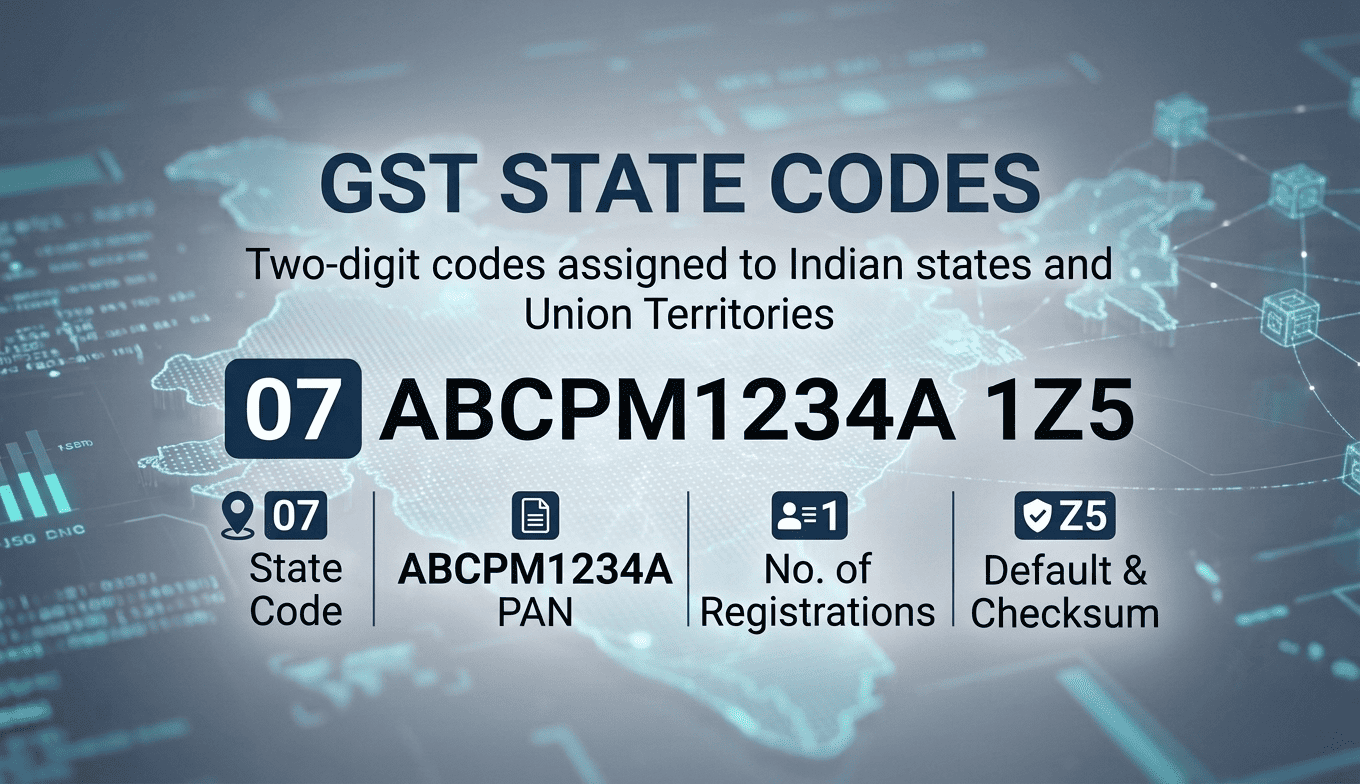
You probably have scrutinized your GSTIN and might have realized that the first two digits are always in a sequence. Distinctly, whether your business is located on the technology frontiers of Karnataka (29) or the commercial centers of West Bengal (19) these numbers are not arbitrary, but your GST State Code, the identifying mark of the location of your business within the extensive GST framework of India.
The GST state code list 2025 and the larger GST jurisdiction list in India are designed to assist the taxpayers, consultants and businesses in registering where they are, invoice properly and remain abreast of reporting conventions. As GST compliance is increasingly becoming system driven, it is no longer a choice to know your GST code and whereabouts zone mapping now is a necessity.
What Is a GST State Code?
GST State Code is a two-digit code that is assigned to all the States and Union Territories (UTs) in India. The first set of these numbers constitutes the GSTIN 15 numbers and they represent the State/UT in which the business is registered.
For example:
- 07 – Delhi
- 02 – Himachal Pradesh
- 19 – West Bengal
- 29 – Karnataka
Therefore, when a GSTIN includes 07ABCDE1234F1Z2, the first thing that will come to mind is that the given business is registered in Delhi.
This simple system helps:
● Taxpayers define their jurisdiction.
● Cases are efficiently allocated by authorities.
● Businesses do not make mistakes in GST returns and invoicing.
Updated GST State Code List 2025
Below is the full state/UT-wise GST code list for 2025:
| State / UT | GST Code |
|---|---|
| Jammu & Kashmir | 01 |
| Himachal Pradesh | 02 |
| Punjab | 03 |
| Chandigarh | 04 |
| Uttarakhand | 05 |
| Haryana | 06 |
| Delhi | 07 |
| Rajasthan | 08 |
| Uttar Pradesh | 09 |
| Bihar | 10 |
| Sikkim | 11 |
| Arunachal Pradesh | 12 |
| Nagaland | 13 |
| Manipur | 14 |
| Mizoram | 15 |
| Tripura | 16 |
| Meghalaya | 17 |
| Assam | 18 |
| West Bengal | 19 |
| Jharkhand | 20 |
| Odisha | 21 |
| Chhattisgarh | 22 |
| Madhya Pradesh | 23 |
| Gujarat | 24 |
| Daman & Diu | 25 |
| Dadra & Nagar Haveli | 26 |
| Maharashtra | 27 |
| Andhra Pradesh (Old) | 28 |
| Karnataka | 29 |
| Goa | 30 |
| Lakshadweep | 31 |
| Kerala | 32 |
| Tamil Nadu | 33 |
| Puducherry | 34 |
| Andaman & Nicobar Islands | 35 |
| Telangana | 36 |
| Andhra Pradesh (New) | 37 |
| Ladakh | 38 |
| Other Territory | 97 |
| Center Jurisdiction | 99 |
In January 2020, code 26 was used to represent the merged UT of Daman & Diu and Nagar Haveli.
GST State Codes: The Exemplification
Examples of GSTIN state codes:
- GST State Code 10 – Bihar
- GST State Code 19 – West Bengal
- GST State Code 36 – Telangana
- GST State Code 33 – Tamil Nadu
- GST State Code 23 – Madhya Pradesh
- GST State Code 20 – Jharkhand
- GST State Code 03 – Punjab
- GST State Code 21 – Odisha
- GST State Code 26 – Dadra and Nagar Haveli and Daman and Diu
These codes are important to registration, invoicing, e-invoicing and filing of returns because GST jurisdictions in India are classified.
Classification of Jurisdiction
GST jurisdiction works on two levels:
A. State Jurisdictions
Handled by state tax authorities; they deal with:
● Majority of small taxpayers
● Local compliance reviews
● State-level assessments
B. Central Jurisdictions
Handled by CBIC; they manage:
● Large taxpayers
● Specific industries/services
● Enforcement of central GST provisions
Allocation Rules (CGST Circular No. 21/2017):
- 90% of taxpayers with turnover < ₹1.5 cr → State
- 10% of taxpayers with turnover < ₹1.5 cr → Centre
- 50% of taxpayers > ₹1.5 cr → State
- 50% of taxpayers > ₹1.5 cr → Centre
The allocation is done via computerized random sampling for fairness.
The Hierarchy of GST Jurisdiction
● Zone
● Commissionerates
● Division Offices
● Range Offices
Every taxpayer falls under one zone → one commissionerate → one division → one range.
How to Find Your GST Jurisdiction?
A. For State GST Jurisdiction
Visit the commercial tax website of your state.
Example (Karnataka):
http://gstkarnataka.gov.in/Jurisdiction.html
Similar pages exist for Tamil Nadu, Gujarat, Maharashtra, Delhi, Kerala, etc.
B. For Central GST Jurisdiction
Use CBIC’s Know Your Jurisdiction tool:
https://cbic-gst.gov.in/cbec-portal-ui/?knowYourJuris
Steps:
● Select your State/UT
● Choose the zone
● Select the commissionerate
● Choose the division
● Review your range
The tool displays range names, officer details, and administrative areas.
How to Get Contact Details of GST Officers?
You can access officer details through:
● State GST portals
● CBIC jurisdiction pages
● “Know Your Jurisdiction” tool
These pages provide contact numbers, emails, office addresses, and designations.
What to Do If GST Jurisdiction Is Incorrect?
If the wrong jurisdiction was chosen during registration:
● Apply to the State GST administrative/IT cell
● Submit address proof + correction request
● The department updates it internally
Fixing it early prevents notices, delays, and processing errors.
Why GST State Code Is So Important
GST state codes affect all major compliance areas:
GST Registration
Correct state code ensures:
● Accurate jurisdiction allocation
● Correct GSTIN generation
● Smooth approval
GST Invoice & E-Invoicing
State code decides:
● Place of supply
● IGST or CGST+SGST
● IRN acceptance
A wrong code can cause wrong tax, IRN rejection, and ITC problems.
GST Returns (GSTR-1, GSTR-3B)
Incorrect GSTIN leads to:
● Wrong credit to another taxpayer
● Reconciliation mismatches
● Lower compliance rating
Businesses must verify GSTINs carefully.
Conclusion
GST compliance depends on understanding where your business is registered, proper tax reporting, the GST state code list 2025, the GST jurisdiction list India and correct GST code and zone mapping. This knowledge prevents errors, ensures smooth audits, and keeps GST returns accurate and compliant.
Whether you are a new or growing business or a tax consultant, knowing your GST state-wise jurisdiction will help you manage compliance confidently and efficiently in 2025 and the years ahead.
FAQ’s
GST state codes are two-digit identification codes assigned to Indian states and Union Territories for GST registration, invoicing, return filing, and identifying the location of a registered taxpayer.
GST state codes help businesses correctly identify the place of registration, prepare GSTINs, issue tax invoices, determine applicable GST treatment, and maintain accurate GST records.
A GST state code consists of two digits. These two digits form the first part of a GSTIN and identify the state or Union Territory associated with the registration.
The GST state code can be identified from the official GST state code list. Businesses can use the applicable two-digit code when checking GSTIN details, preparing invoices, or verifying registration information.
The GST state code for Gujarat is 24. It appears as the first two digits of a GSTIN issued for a registration in Gujarat.
The first two digits of a GSTIN represent the state or Union Territory code. The remaining characters identify the taxpayer and registration details according to the GSTIN structure.
Yes. Union Territories also have designated GST state codes. These codes are used in GST registrations, invoices, returns, and other GST-related records in the same way as state codes.
Yes. The first two digits of a GSTIN indicate the state or Union Territory linked to the GST registration, making the GST state code useful for identifying the registration location.
Using an incorrect GST state code can lead to inaccurate GSTIN or invoice information and may create reconciliation and compliance issues. Businesses should verify the state code before issuing GST documents.
Accounting software can help businesses maintain accurate customer and supplier GST details, generate GST-compliant invoices, manage tax records, and reduce manual errors when working with GST registrations and state-specific information.