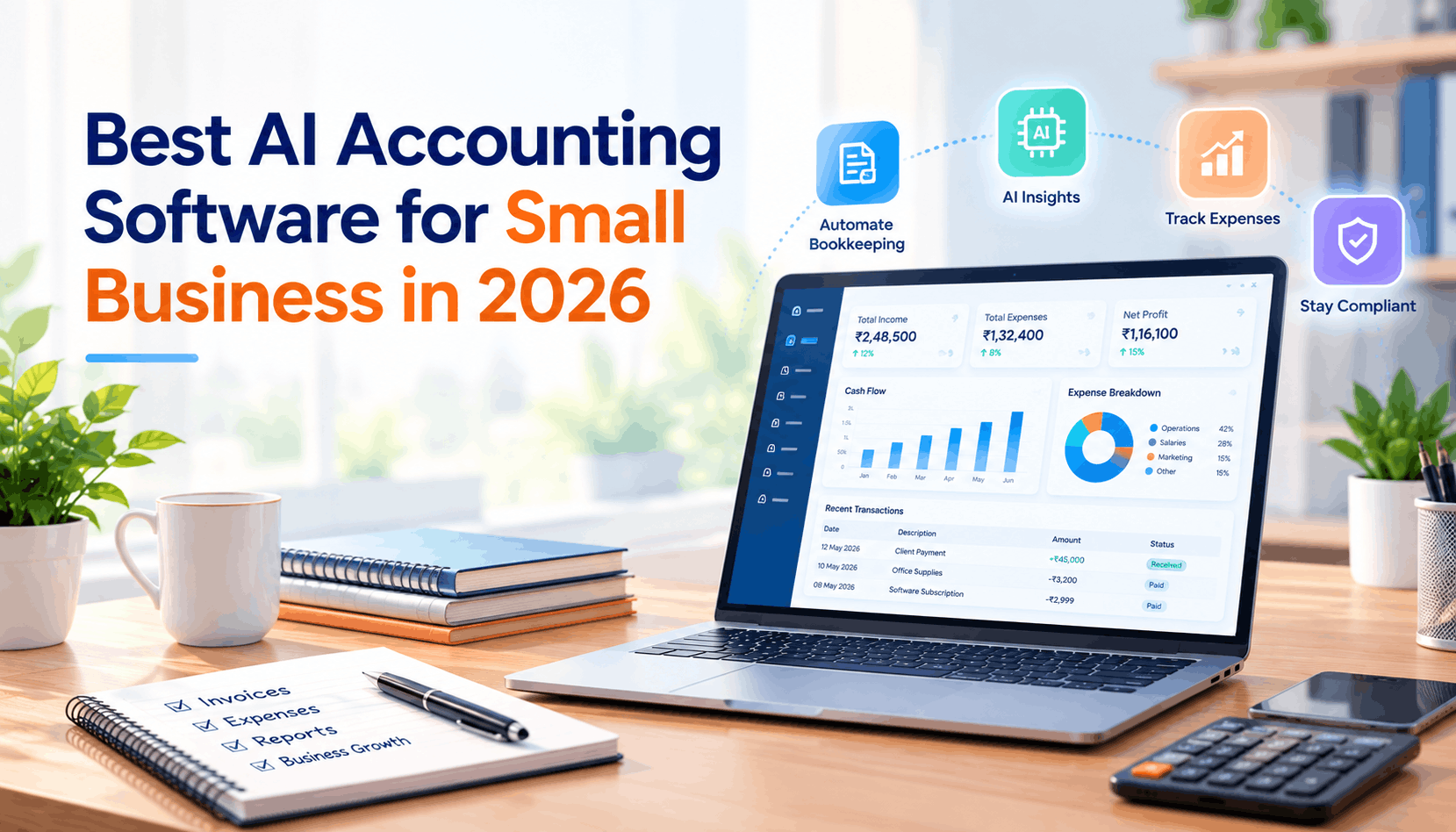
Choosing accounting software is no longer only about recording sales, purchases, expenses, and GST transactions. In 2026, small businesses are increasingly looking for software that can also reduce manual data entry, identify unusual transactions, simplify reconciliation, and turn financial data into useful information.
That is where AI-powered accounting software in India is becoming relevant.
But there is an important distinction: not every accounting product that mentions AI provides the same type of intelligence. Some use AI for document processing, some for bank categorisation or anomaly detection, while others focus mainly on conversational assistance and reporting.
This guide explains what to look for in AI finance software, how leading accounting platforms compare, and where a cloud accounting platform such as WebLedger Books fits into the wider accounting software India market.
What Is AI Accounting Software?
AI accounting software uses artificial intelligence, machine learning, OCR, or related automation technologies to reduce manual accounting work and help users understand financial information.
Traditional accounting software mainly follows rules entered by the user. AI-enabled software can assist with tasks such as:
- Extracting information from invoices and documents
- Categorising transactions
- Matching banking transactions
- Detecting unusual changes in financial data
- Generating financial insights
- Forecasting selected financial metrics
- Creating payment reminders
- Answering questions about accounting data
- Automating repetitive accounting workflows
The important point is that AI should support accounting workflows, not replace financial judgement. Businesses still need appropriate review and controls before financial entries, tax filings, payments, or other important decisions are finalised.
Why Are Small Businesses Looking at AI Powered Accounting Software?
For a small business, accounting problems rarely come from one complicated transaction. They usually come from hundreds of small tasks.
Invoices need to be entered. Bank transactions need to be matched. Customers need payment reminders. GST information needs to be checked. Reports need to be reviewed.
AI can help reduce some of this repetitive work.
For example, TallyPrime’s current AI offering, Docs by Ira, can scan or upload invoices and create accounting ready draft entries for review. Tally states that this can reduce manual effort and save up to 80% of processing time; the claim is from Tally and should therefore be evaluated against the business’s actual documents and workflow.
Zoho Books takes a broader approach. Its Zia capabilities include conversational queries, anomaly detection, AI forecasts, report insights, invoice and collection assistance, and AI assisted bank statement categorisation.
This illustrates an important point: AI accounting is a collection of capabilities, not one single feature.
What Should You Look for in the Best AI Accounting Software in India?
Before comparing software, define what “AI” actually needs to do for your business.
1. AI based document processing
If your business receives many supplier invoices, document processing can be one of the most practical AI applications.
Look for software that can extract information from invoices or documents and convert it into accounting entries that can be reviewed before posting.
2. Bank reconciliation and transaction categorisation
Bank reconciliation can become time consuming as transaction volume grows.
Good accounting software should reduce repetitive matching and categorisation while still giving the user enough control to review exceptions.
3. AI insights and anomaly detection
AI can be useful for identifying unusual movements in financial data.
For example, software may flag an unusual expense increase or a significant change in revenue. Zoho Books currently describes machine learning based anomaly detection and AI generated insights as part of its accounting capabilities.
4. GST and Indian compliance
AI features are useful only if the underlying accounting system works for Indian businesses.
Depending on the business, look for:
- GST accounting
- GSTR related reporting
- E-invoicing
- E-way bills
- HSN/SAC handling
- Input tax credit tracking
- Bank reconciliation
- Financial reports
Zoho Books, TallyPrime, BUSY and other established Indian accounting platforms provide various combinations of these capabilities.
5. Human review and audit controls
This is easy to overlook.
AI generated accounting entries should not automatically be treated as correct simply because software generated them. Review mechanisms, edit trails, approvals, and clear visibility into the source transaction remain important.
For example, TallyPrime’s Docs by Ira workflow specifically describes AI-created entries as drafts that users review before saving.
6. Cloud and mobile access
A small business owner may need to check sales, purchases, receivables, inventory, or financial reports outside the office.
Cloud accounting can make financial information accessible across locations and devices, provided appropriate security and access controls are in place.
Best AI Accounting Software in India for Small Businesses
There is no single accounting platform that fits every business. The right choice depends on whether you prioritise AI automation, traditional accounting depth, GST workflows, inventory, cloud access, or a particular business process.
Here are some platforms worth evaluating in 2026.
| Software | AI / automation focus | Accounting & GST | Suitable for |
|---|---|---|---|
| Zoho Books | AI assistant, insights, anomaly detection, forecasts, categorisation and workflow assistance | Strong Indian GST and accounting capabilities | Small and growing businesses |
| TallyPrime | AI document processing through Docs by Ira plus banking and accounting automation | Strong accounting, GST and compliance capabilities | Businesses already using or considering Tally workflows |
| BUSY | AI-powered workflows in BUSY Magic, including AI voucher scanning | Accounting, GST, inventory and reporting | Indian MSMEs |
| WebLedger Books | Workflow and accounting automation; current product positioning focuses on cloud accounting rather than claiming a broad AI layer | Accounting, GST, e-invoice, e-way bill, inventory and reporting | Businesses and CA firms looking for cloud accounting |
This is a feature oriented comparison, not a ranking. Capabilities and plans can change, so businesses should verify the current product documentation before purchasing.
Zoho Books
Zoho Books has one of the more clearly documented AI approaches among mainstream accounting platforms in India.
Its current AI capabilities include Ask Zia, anomaly detection, AI forecasts, report insights, invoice collection assistance, bank statement categorisation, and AI assisted workflows.
Zoho Books also supports Indian accounting requirements including GST, e-invoicing, e-way bills, banking, inventory and financial reporting.
It can be worth considering if your priority is having AI capabilities directly inside a broader cloud accounting platform.
TallyPrime
Tally Solutions TallyPrime remains an established option for Indian accounting workflows.
Its newer AI capabilities include Docs by Ira, which processes uploaded or scanned invoices and creates draft accounting entries. Tally also provides connected banking, reconciliation, GST capabilities, inventory and reporting.
For businesses already familiar with Tally’s accounting environment, the newer AI capabilities may be particularly relevant because they are being added to an established accounting workflow rather than requiring a separate AI tool.
BUSY
BUSY is another established accounting platform focused on Indian small and medium businesses.
BUSY currently describes BUSY Magic as providing AI powered workflows, including AI voucher scanning, alongside billing, GST, inventory, vouchers and reporting.
Its broader accounting platform covers billing, GST, inventory, bank reconciliation, outstanding payments and reporting.
WebLedger Books
WebLedger Books takes a cloud first accounting approach for modern businesses.
Its current product positioning includes cloud accounting, billing, dashboards and reports, e-way bills, e-invoicing, multi-branch automation, e-commerce automation and inventory management.
For a business that primarily wants cloud accounting and operational automation rather than choosing software solely because it has the largest collection of AI features, this distinction matters.
WebLedger Books also supports accounting workflows such as multi-business access, multi-branch accounting, GST reconciliation, GSTR-1, e-invoicing, e-way bills, inventory, bank imports and mobile accounting based on the product capabilities provided for this article.
The key consideration is simple: do not choose accounting software because the word “AI” appears on its website. Choose it based on the actual accounting problems it solves.
AI Accounting Software vs Traditional Accounting Software
The difference is becoming less about whether software is “AI” or “not AI” and more about how much manual work the system can remove.
| Area | Traditional approach | AI-assisted approach |
|---|---|---|
| Invoice entry | Manual entry | Data can be extracted from documents |
| Transaction categorisation | Rules/manual selection | AI-assisted categorisation |
| Bank reconciliation | Manual matching | Automated or suggested matching |
| Reports | User reviews numbers | AI can summarise or highlight patterns |
| Anomalies | Found during manual review | Software can flag unusual activity |
| Forecasting | Spreadsheet/manual analysis | AI-assisted forecasts may be available |
| Payment follow-up | Manual reminders | Automated or AI-assisted reminders |
This does not mean AI is automatically more accurate.
The quality of the underlying accounting data, configuration, source documents, business rules and human review still matters.
Illustrative Example: A Small Trading Business
Consider a small wholesaler receiving dozens of purchase invoices every month.
Situation
The owner maintains accounts while also managing purchasing, sales and inventory.
Problem
Supplier invoices have to be entered manually. Bank transactions need reconciliation. Stock and receivables need regular review.
Action
The business evaluates accounting software that combines GST accounting, inventory, banking and automation. If AI document processing is available, invoices can be scanned and converted into draft entries for review.
Result
The potential benefit is not simply “using AI.” The real benefit is reducing repetitive data entry and giving the owner more time to review exceptions, cash flow and business performance.
Lesson
Choose AI according to the workflow you want to improve.
If invoice entry is the bottleneck, document processing matters. If financial review is the bottleneck, insights and anomaly detection may matter more. If GST and inventory are the bigger concerns, those capabilities should take priority over a flashy AI feature.
Common Mistakes When Choosing AI Finance Software
Choosing software because it says “AI”
Why it happens: AI has become a popular product term.
Why it matters: A chatbot does not necessarily improve bookkeeping.
What to do instead: Ask exactly which accounting tasks AI automates.
Ignoring Indian compliance
Why it happens: Some international accounting products have attractive AI features.
Why it matters: Indian businesses may require GST, e-invoicing, e-way bills and other local workflows.
What to do instead: Check the compliance capabilities before comparing AI features.
Automating without review
Why it happens: Automation sounds attractive because it reduces manual work.
Why it matters: An incorrect categorisation or extracted value can affect financial records.
What to do instead: Keep review and approval controls for important accounting actions.
Comparing only subscription prices
Why it happens: Price is easy to compare.
Why it matters: Additional users, branches, inventory, integrations, support or compliance services can affect the actual cost.
What to do instead: Compare the total workflow and required capabilities, not just the advertised base price.
How to Choose the Right AI Accounting Software
Before signing up, answer these questions:
- What accounting task consumes the most time today?
- Does the software automate that exact task?
- Does it support the GST and compliance workflows your business requires?
- Can your accountant access the same financial data?
- Does it support your inventory requirements, if applicable?
- Can you access accounts remotely?
- What happens when the AI makes an incorrect suggestion?
- Can users review and approve AI generated entries?
- Are reports available in the format your business needs?
- What will the total cost be after adding users, branches or required services?
A short product demonstration can often answer these questions faster than reading dozens of feature pages.
Is AI Really Necessary for a Small Business?
Not necessarily.
A very small business with a low transaction volume may only need reliable invoicing, bookkeeping, GST reporting and basic financial statements.
AI becomes more useful when the volume of repetitive accounting work increases.
For example, a business handling many invoices, bank transactions, customer payments or financial reports may benefit more from automation than a business with only a few transactions each month.
The goal should therefore be less manual accounting work and better financial visibility, rather than simply having an AI label.
What Should Small Businesses Expect From AI Accounting in 2026?
The direction of accounting software is moving beyond simple transaction recording.
Current products are adding capabilities around:
- Document understanding
- Conversational finance queries
- Automated categorisation
- Anomaly detection
- Forecasting
- Collection assistance
- Workflow creation
- Bank reconciliation
- AI generated financial explanations
Zoho Books, for example, now describes AI capabilities that allow users to ask questions in plain language, identify unusual report movements, generate forecasts and take actions from AI assisted workflows.
TallyPrime is also adding AI powered document processing through TallyIra and Docs by Ira.
The practical implication for a small business is straightforward: accounting software is increasingly becoming an active assistant around the accounting workflow, rather than only a digital ledger.