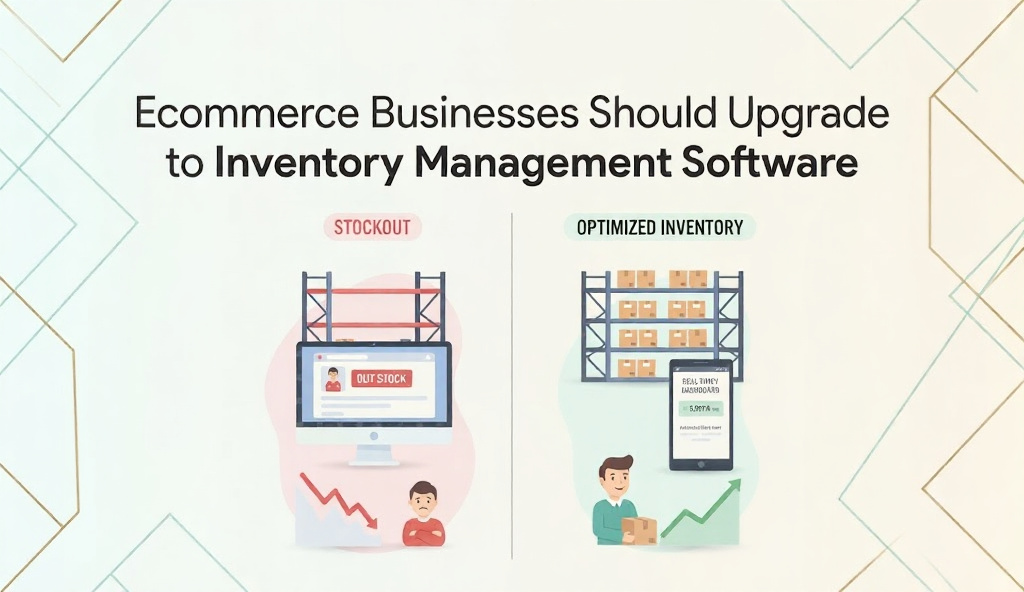
When an ecommerce business is small, keeping track of stock usually isn’t that difficult.
You might have a spreadsheet, a warehouse shelf, and a fairly good idea of what has sold during the week. If there are only a few products and orders are coming from one place, that can work perfectly well.
The trouble starts when the business grows.
Suddenly, there are more SKUs to keep track of. Some products have different sizes or colours. Orders are coming from the website as well as marketplaces. There may be stock sitting in two warehouses, products on the way from suppliers, and a growing pile of returns that still need to be checked.
At that point, inventory is no longer something you can keep in your head or update casually in a spreadsheet.
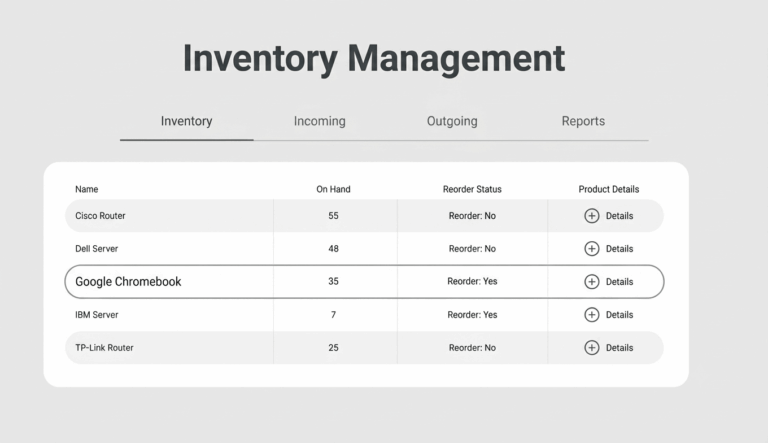
This is where ecommerce inventory management software becomes useful. It gives the business one place to keep track of stock and the transactions that change it, so the team isn’t constantly trying to work out which number is correct.
What does ecommerce inventory management software actually do?
At its simplest, inventory software keeps track of products as they move through the business.
Stock comes in from a supplier. A customer places an order. A product gets shipped. Someone returns an item. A damaged product is removed from sale. Another batch arrives at the warehouse.
All of those events change the amount of stock the business can actually sell.
A spreadsheet can record those changes, but someone has to remember to make each update. And when there are hundreds or thousands of transactions, small mistakes start to add up.
Inventory software is designed to handle these movements as part of the normal sales and purchasing process.
It also helps answer questions that become surprisingly difficult as an ecommerce business grows:
- How much stock do we actually have?
- How much of it is already committed to orders?
- Which products are running low?
- What stock is arriving from suppliers?
- Which warehouse has a particular product?
- How much inventory has been returned?
- Which products are sitting around without selling?
Having those answers quickly can make a real difference to day-to-day decisions.
Why does inventory become such a problem as an ecommerce business grows?
The issue isn’t usually that businesses don’t care about their inventory.
It’s that there are more things happening at the same time.
Imagine an online business selling 300 products. It starts with its own website, then adds Amazon. A year later, it opens another warehouse.
Now the same product can be sold in several places, while the physical stock may be stored somewhere else entirely.
Someone might update the website stock in the morning, while an Amazon order comes in later. A purchase order may already be on its way, but it isn’t available to sell yet. Then a customer sends something back.
The business may still have plenty of inventory. It just doesn’t necessarily know exactly where that inventory is or what state it is in.
That distinction is one of the biggest reasons growing ecommerce companies move away from manual stock tracking.
1. You get a much clearer picture of your stock
One of the biggest advantages of inventory software is also one of the simplest: you can see what’s happening with your products.
There is a difference between having 100 units somewhere in the business and having 100 units available to sell.
For example, a business might physically have 100 units of a product, but:
- 20 have already been sold and are waiting to be shipped
- 10 are damaged
- 15 are being held for another reason
- 25 are in a different warehouse
- 30 are genuinely available
Looking only at the physical quantity can give a misleading picture.
A proper inventory system helps the business keep these situations separate. That makes it easier for sales and purchasing teams to work with the same information instead of maintaining their own versions of the truth.
2. It can reduce overselling
Overselling is one of those problems that can look small from the warehouse but feel much bigger to the customer.
Suppose there are only three units of a product left.
One customer buys two through your website. Around the same time, another customer buys two through a marketplace.
If the available quantity isn’t updated properly, you’ve just sold four products that you only had three of.
Someone now has to contact a customer, explain the situation and work out what to do about the order.
That isn’t good for the customer, and it creates unnecessary work for the team.
Inventory software can keep track of stock movements as orders come in and, where the relevant sales-channel connections are supported, help keep available quantities consistent across channels.
It doesn’t mean overselling becomes impossible. Businesses still need accurate product data and properly configured systems. But removing manual updates from the process can eliminate a common source of mistakes.
3. You can stop guessing when it’s time to reorder
Buying inventory is a balancing act.
Order too little and you run out of products people want. Order too much and cash gets tied up in stock that may sit in the warehouse for months.
Neither problem is particularly pleasant.
Inventory software can give purchasing teams a better starting point by showing current stock, sales activity and incoming purchases in one place. That makes it easier to spot products that need attention before they become an emergency.
It is still important to use judgement.
A product that normally sells 20 units a month might suddenly sell 100 because of a festival, promotion or social media post. Software cannot know every reason demand might change.
What it can do is make the information easier to see.
That alone is better than opening three spreadsheets and trying to work out which one was updated yesterday.
4. Managing several sales channels becomes easier
Selling on multiple channels is good for growth, but it makes inventory harder to manage.
A business might have its own website, Amazon, Flipkart and another marketplace. If each channel is treated separately, the team can quickly end up spending a lot of time checking and correcting stock quantities.
This is particularly frustrating when the same SKU is sold everywhere.
A central inventory system gives the business a common record of stock. Depending on the software and integrations being used, inventory changes can then be reflected across the relevant sales channels.
The important thing to check before buying software is exactly which channels it supports and how the synchronisation works. Not every inventory system works with every marketplace, and “integrated” can mean different things from one product to another.
5. Returns stop disappearing into a black hole
Returns deserve more attention than they usually get.
A customer sends back a shirt. That doesn’t necessarily mean the shirt should immediately appear as available stock.
Someone may need to check it first.
Is it unused and ready to sell again? Is the packaging damaged? Is the product defective? Should it be written off?
These are different inventory outcomes.
If returns are simply added back into the available quantity, the system can say that a product is ready to sell when it is actually sitting in a returns area waiting to be inspected.
For businesses dealing with a large number of ecommerce returns, having a proper process for these movements can make inventory records much more trustworthy.
6. Your team spends less time fixing spreadsheets
There is nothing wrong with using Excel or Google Sheets to manage inventory.
In fact, they can be perfectly sensible when a business is small.
The problem is using a spreadsheet long after the business has outgrown it.
Someone has to update sales. Someone else checks purchase orders. Another person adjusts the stock after returns. Then the finance team wants to compare the inventory numbers with the accounts.
Eventually, the spreadsheet isn’t really saving time anymore.
It has become another job.
Moving to inventory management software isn’t about getting rid of spreadsheets because spreadsheets are “bad”. It’s about deciding whether manual data entry is still the best way to run an increasingly complicated process.
7. Inventory and accounting can work together
Inventory isn’t just a warehouse issue.
The products a business buys and sells affect its financial records too. Purchases, sales, returns and inventory values all have a financial side.
When accounting and inventory are completely separate, businesses can end up entering the same information more than once or spending time checking why the numbers don’t match.
This is particularly relevant for Indian ecommerce businesses dealing with GST, marketplace sales, returns and settlements.
Webledger’s ecommerce guidance focuses on bringing accounting, GST and inventory into a connected workflow, rather than making businesses manage each area separately.
For a business that is already using Webledger, or is considering it, this is one area worth looking at closely.
When is it actually time to upgrade?
Not every ecommerce business needs inventory software on day one.
If you’re selling 20 products through one website and you can comfortably keep your stock records accurate, there may not be much reason to introduce another system.
The situation changes when inventory starts taking up too much of your team’s time.
Some warning signs are:
- You regularly find differences between physical stock and your records.
- Products are being oversold.
- You sell through several marketplaces.
- You have more than one warehouse or storage location.
- Nobody is completely sure when to reorder a product.
- Returns aren’t being recorded consistently.
- Staff members maintain different stock spreadsheets.
- Your finance and inventory figures don’t agree.
- You spend hours every week checking or correcting stock.
- You have grown enough that one person can no longer keep track of everything manually.
There isn’t a magic number of orders where every business needs software.
A better question is: Is managing inventory manually starting to slow the business down or create mistakes?
If the answer is yes, it is probably time to look at alternatives.
What should you look for in inventory software?
Don’t start by looking at the longest feature list.
Start with the problems you actually have.
If you sell through several marketplaces, check the available sales channel integrations.
If you have two warehouses, check how locations are handled.
If you sell clothing, electronics or other products with lots of variations, check how SKUs and product variants are organised.
If returns are a big part of your business, look carefully at the return and stock-adjustment process.
Some useful things to check include:
| What to check | Why it matters |
|---|---|
| Stock by location | Helps you know where products actually are |
| Sales-channel connections | Reduces the need to update different channels manually |
| Purchase tracking | Helps you see what has been ordered and what is still coming |
| Returns | Makes it easier to separate sellable and unsellable stock |
| Stock adjustments | Gives the team a proper way to correct inventory |
| Reports | Helps with purchasing and identifying slow-moving stock |
| Accounting connection | Reduces duplicate work between finance and operations |
| Ease of use | A system is only useful if the team actually uses it |
And don’t just sit through a sales demo.
Give the software a real example from your business.
Ask the vendor to show you what happens when a customer orders the last unit, when that customer returns it, when another warehouse receives new stock, and when you need to reorder the product.
You’ll learn much more from that than from a list of features.
A simple example of when a spreadsheet stops working
Consider a small Indian ecommerce business selling home products.
At first, the owner has around 40 SKUs and sells through its website. Inventory is tracked in a spreadsheet and updated every evening.
For a while, this works.
Then the business starts selling through a marketplace. It adds another 100 products and begins keeping some stock with a fulfilment partner.
The owner now has to keep an eye on website orders, marketplace orders, warehouse stock and incoming purchases.
A product that looks available in the spreadsheet may already have been sold. Another product may be sitting with the fulfilment partner but not be reflected in the same file.
Nothing has necessarily gone “wrong”. The business has simply reached a level of complexity where the old process is no longer comfortable.
That is often the point at which inventory software starts making sense.
Where can Webledger fit?
Webledger is relevant for businesses looking for more than a standalone stock-counting tool.
Its published information describes Webledger Books as an accounting platform with GST and inventory capabilities. The company also highlights stock movement and inventory value tracking, multi-business and multi-branch support, and ecommerce sales-data import.
For an ecommerce business that wants accounting and inventory information to sit within the same broader system, that can be worth considering.
The right choice will still depend on the business.
Before committing, check whether the product supports your particular marketplaces, inventory setup, reporting requirements and internal workflow. A system that works well for a small D2C brand may not be the right choice for a business with several warehouses and a large catalogue.
Don’t automate a bad inventory process
There is one mistake worth avoiding when moving to new software: assuming the software will fix everything automatically.
It won’t.
If your current stock records are wrong, importing them into new software simply gives you wrong records in a nicer interface.
Before switching, clean up your product list. Check SKU names. Count physical stock. Remove duplicate products. Decide how damaged and returned goods should be treated.
Then set up the software around the way your business actually operates.
A little preparation at this stage can save a lot of frustration later.
Is upgrading worth it?
For a small ecommerce business, probably not always.
For a growing business where stock is spread across several channels, locations and processes, the answer is more likely to be yes.
The biggest benefit isn’t that inventory software makes the business look more sophisticated. It is that the team spends less time asking, “Which number is correct?”
When everyone can work from the same inventory information, purchasing becomes easier, fulfilment becomes more predictable, returns are easier to account for, and the finance team has fewer numbers to reconcile.
That’s a much more practical reason to upgrade.