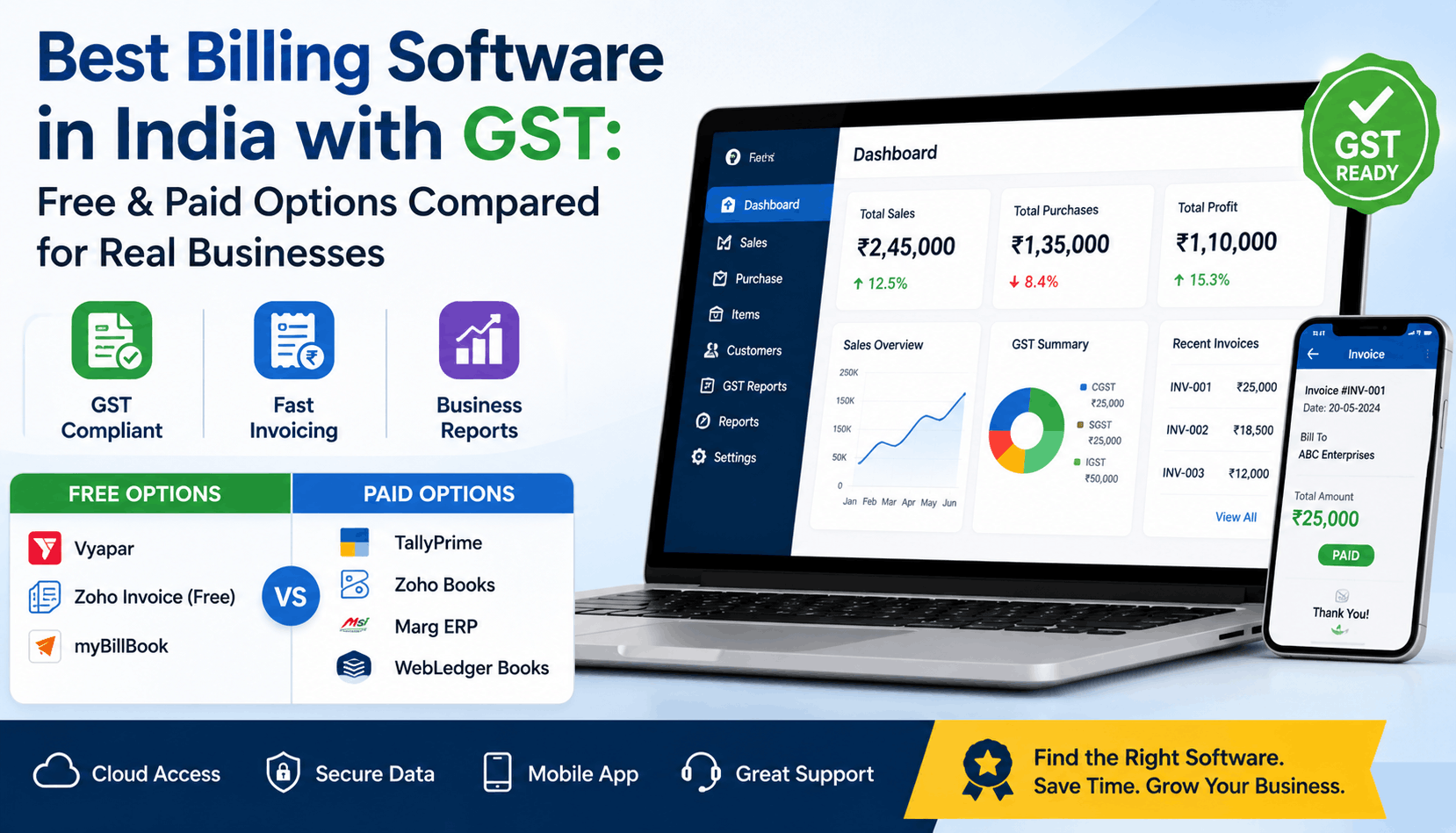
A lot of businesses don’t switch billing software because they want “digital transformation.” They switch because something breaks.
Sometimes it’s a GST mismatch discovered two days before filing. Sometimes the accountant calls asking why sales invoices and stock reports don’t match again. And sometimes the owner is simply tired of running billing, inventory, and payments from three different Excel files.
That’s usually where the search for Billing Software India businesses can actually rely on begins.
The problem is, most comparison articles online sound identical. Every software claims to save time, automate operations, and simplify accounting. But once you start using them daily, the differences become obvious very quickly.
Some are great for GST filing but terrible for inventory. Some look modern but slow down when invoice volume increases. Others work perfectly… until customer support stops responding during return filing week.
This comparison is based on practical usage patterns, not just feature lists.
What Businesses Actually Need From Billing Software
Most small businesses are not looking for a giant ERP system.
They usually want four things:
- Fast invoice creation
- Proper GST reports
- Easy stock tracking
- Fewer manual mistakes
That sounds simple. In reality, many software tools still struggle with basic workflows.
One Ahmedabad-based distributor I spoke with recently had premium accounting software installed across multiple systems. Yet every month, staff still exported data into Excel manually because purchase reconciliation wasn’t working properly.
That happens more often than software companies admit.
Features That Matter More Than Fancy Dashboards
GST Compliance
This is non-negotiable now.
A proper GST billing software should handle:
- GST invoices
- GSTR-1 reports
- E-way bills
- E-invoicing
- Purchase reconciliation
Here’s where things get tricky.
Some software generates GST invoices perfectly but becomes frustrating during actual filing. Reports need cleanup, entries mismatch, or exports fail when data volume increases.
That’s the real test, not the homepage demo.
Fast Billing
Retail businesses especially understand this.
If invoice generation takes even 15-20 extra seconds during busy hours, staff gets irritated quickly.
A good invoice software India businesses prefer should feel fast even on average systems. Not every shop has high-end hardware or dedicated IT staff.
Simple things matter:
- Barcode billing
- Quick product search
- WhatsApp invoice sharing
- Shortcut keys
- Mobile billing access
Inventory Tracking
Most people ignore inventory features while buying software. Then six months later, stock mismatches start showing up.
Good inventory management should include:
- Real-time stock updates
- Batch tracking
- Low-stock alerts
- Purchase tracking
- Multi-location inventory
If your business handles physical products regularly, weak inventory features become a daily problem very quickly.
Best Billing Software in India Compared
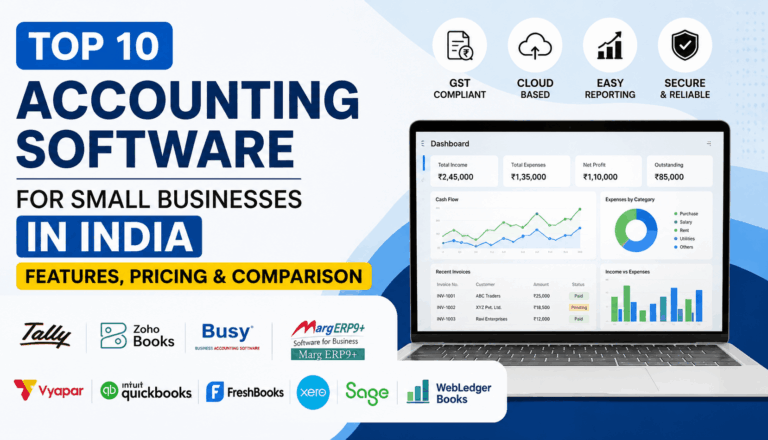
1. TallyPrime
Best suited for:
Traditional businesses, accountants, trading firms
Tally is still everywhere. Walk into most CA offices and you’ll probably find it running on at least one system.
There’s a reason for that.
It’s stable, accountants understand it deeply, and it handles accounting workflows well.
What works well
- Strong accounting system
- GST reports
- Inventory support
- Reliable for established businesses
What becomes frustrating
The interface feels old now. New staff often need training before becoming comfortable with it.
Also, many businesses end up depending heavily on accountants for everyday corrections.
Pricing
Starts around Rs. 18,000 for a single-user license.
2. Vyapar
Best suited for:
Retail shops and very small businesses
Vyapar became popular because it removed complexity.
A lot of shop owners don’t want advanced accounting menus everywhere. They just want to create bills quickly and track payments without confusion.
And honestly, for many businesses, that’s enough.
Key strengths
- Easy GST billing
- Mobile app support
- Payment reminders
- Simple inventory management
- Beginner-friendly setup
Limitations
As businesses grow, reporting depth can feel limited.
One retailer I know started with Vyapar and loved it initially. But after opening a second branch, tracking combined inventory and reporting became harder than expected.
Pricing
Free version available. Paid plans start around Rs. 3,000/year.
3. Zoho Books
Best suited for:
Startups, agencies, service businesses
Zoho Books feels modern from the beginning.
The dashboard is cleaner than many traditional systems, and automation features are genuinely useful for service businesses handling invoices, recurring payments, and client communication.
What users like
- Cloud access
- Bank reconciliation
- Workflow automation
- Client portal
- Online payment integration
The downside
Inventory handling is not its strongest area.
Businesses focused heavily on physical inventory sometimes end up adding separate tools later.
That increases software costs faster than expected.
Pricing
Free plan available for eligible businesses. Paid plans start around Rs. 899/month.
4. Marg ERP
Best suited for:
Pharma, wholesale, distribution businesses
Marg is extremely detailed.
Some businesses love that. Others find it overwhelming initially.
But in industries like pharma distribution, batch management and inventory depth matter more than beautiful dashboards.
Strong points
- Advanced inventory
- Batch tracking
- Distribution workflows
- GST billing
- Industry-specific controls
Challenges
The learning curve is real.
New users sometimes struggle during initial setup because there are simply too many operational layers.
Pricing
Depends on modules and business requirements.
5. WebLedger Books
Best suited for:
Businesses needing GST, accounting, and operational simplicity together
WebLedger Books focuses heavily on practical Indian business workflows rather than adding unnecessary complexity.
That difference becomes noticeable during day-to-day usage.
Features
- GST billing & reports
- Direct GSTR-1 filing
- E-way bill generation
- E-invoicing
- Bank statement import
- Inventory management
- Mobile app access
- Real-time P&L and balance sheet
One genuinely useful thing is the reduced dependency on manual Excel handling. Especially for GST-heavy businesses, that saves more time than people expect initially.
Pricing
Starts from Rs. 2,999/year.
What businesses usually like
- Easier GST workflows
- Useful automation
- Multi-business handling
- Practical reporting structure
Where it fits best
Businesses that want compliance and accounting together without the complexity of large ERP systems.
Free Billing Software: Is It Actually Enough?
For very small businesses, yes. At least initially.
But free billing tools usually come with hidden limitations:
- Invoice caps
- Restricted users
- Limited reports
- No advanced reconciliation
- No e-invoicing
The real issue is not invoice creation. It’s compliance once transaction volume increases.
A business generating 20 invoices monthly can manage with basic tools.
A business generating 500 invoices monthly? Completely different story.
Cloud vs Desktop Billing Software
Cloud Software
Good for:
- Multi-branch businesses
- Remote access
- Owners checking reports from phones
Benefits:
- Automatic backup
- Access from anywhere
- Easier collaboration
Most newer businesses now lean toward cloud-based accounting software India providers because owners rarely sit in one office all day anymore.
Desktop Software
Still preferred by:
- Offline-heavy businesses
- Traditional firms
- Businesses wanting local data storage
Benefits:
- Faster local processing
- One-time license options
- Less internet dependency
There’s no perfect answer here. It depends entirely on operational style.
Common Mistakes While Choosing Billing Software
Buying Based Only on Price
Cheap software becomes expensive when staff spends hours correcting reports manually.
That hidden operational cost is rarely discussed.
Ignoring GST Workflow Testing
Always test:
- GSTR reports
- Purchase reconciliation
- E-way bill generation
- Export functionality
Demo videos never show real operational friction.
Assuming Bigger Software Means Better Software
Sometimes smaller, focused systems work better because teams actually use them properly.
Overcomplicated software often creates dependency on one “expert employee” who knows how everything works.
That becomes risky.
Frequently Asked Questions
Find answers to common questions about billing software in India.
Final Thoughts
Choosing the right Billing Software India businesses genuinely benefit from has less to do with marketing claims and more to do with daily usability.
A software may look impressive during a sales demo. But the real test happens during month-end closing, GST filing week, stock reconciliation, or when staff needs to create 200 invoices without delays.
That’s when strengths and weaknesses become obvious.
My honest suggestion? Don’t decide based only on feature lists.
Create sample invoices. Import bank entries. Check GST reports yourself. Try inventory workflows with actual products.
You’ll understand more in one hour of practical testing than after reading ten software comparison pages.