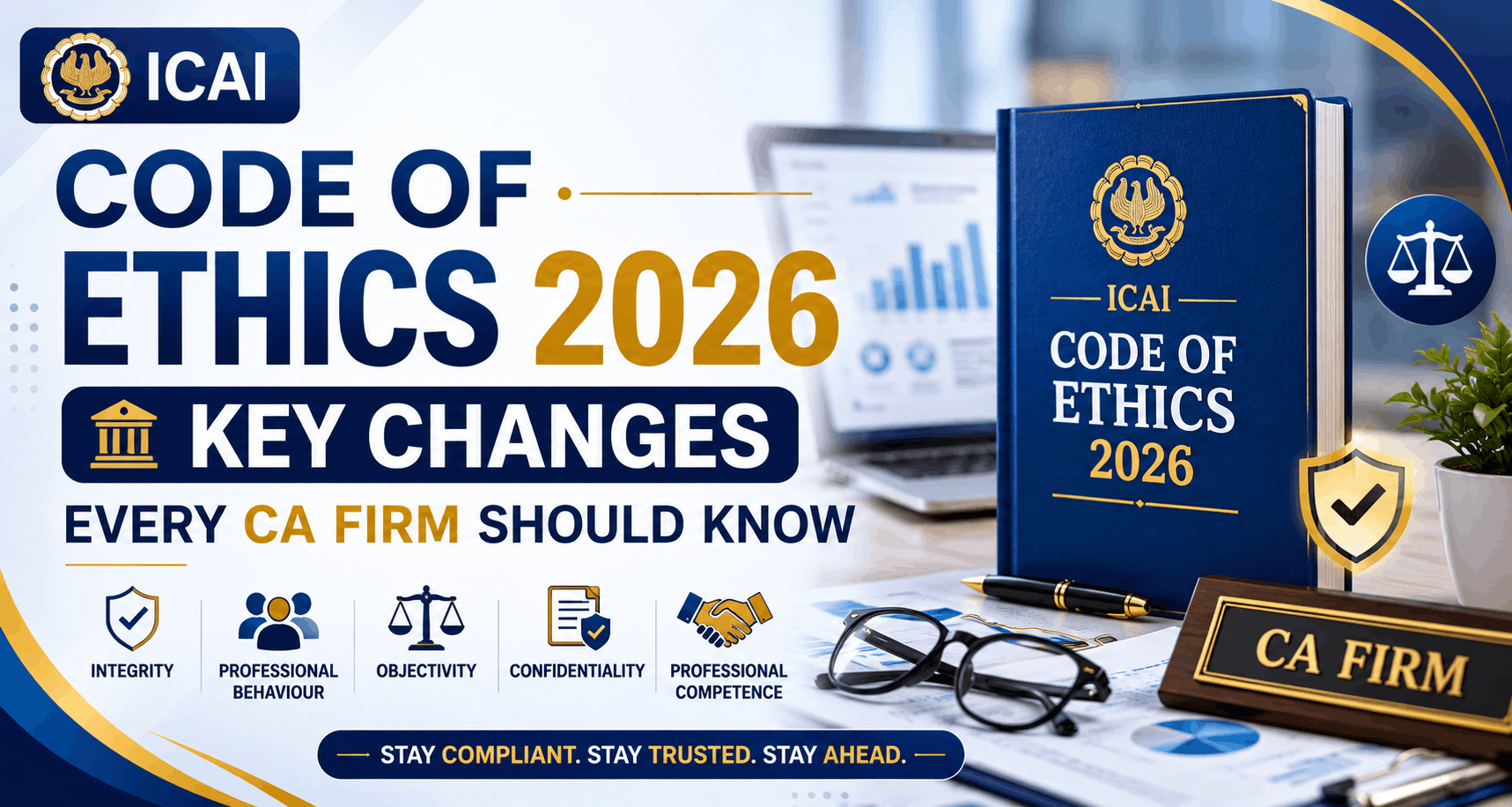
If you run a CA practice, you’ve probably heard the buzz around the ICAI Code of Ethics 2026. The Institute of Chartered Accountants of India approved a revised 13th Edition of its Code of Ethics, and it came into force on 1st April 2026. For many practitioners, this is the first major update to advertising and practice rules in decades.
This article breaks down what’s actually changed, what’s stayed the same, and what it means for your day-to-day practice.
What Are the Key Changes in ICAI Code of Ethics 2026?
In short: CA firms can now build a stronger digital presence, advertise their services within defined limits, take on a wider range of advisory work including sustainability assurance, and operate under rules that align more closely with international ethics standards. The fundamental principles of integrity, objectivity, and confidentiality remain untouched.
Let’s go through each of these in detail.
What Is the ICAI Code of Ethics?
The Code of Ethics is the rulebook that governs how Chartered Accountants in India conduct themselves professionally. It covers everything from how you communicate with clients, to how you maintain independence during audits, to how you can (and can’t) promote your firm.
Earlier editions were largely shaped by an era when print media and word-of-mouth referrals were the only realistic ways for a CA firm to be known. The Revised ICAI Code of Ethics brings this framework into the digital age.
Why Did ICAI Revise the Code in 2026?
A few things were pushing this change. Clients, job seekers, and the public increasingly expect to find professional firms online – a CA firm without a website or LinkedIn presence can come across as outdated. At the same time, ICAI wanted to converge with the 2024 edition of the International Ethics Standards Board for Accountants (IESBA) Code, partly to support the government’s push for larger, globally competitive Indian audit and consulting firms.
The revised code converges with the 2024 edition of the International Ethics Standards Board for Accountants Code of Ethics, in line with a commitment to adopt high international ethical standards while implementing stringent auditor independence provisions. The amendments were approved at ICAI’s 447th Council Meeting in December 2025, with the revised code taking effect from 1st April 2026.
Key Changes in ICAI Code of Ethics 2026
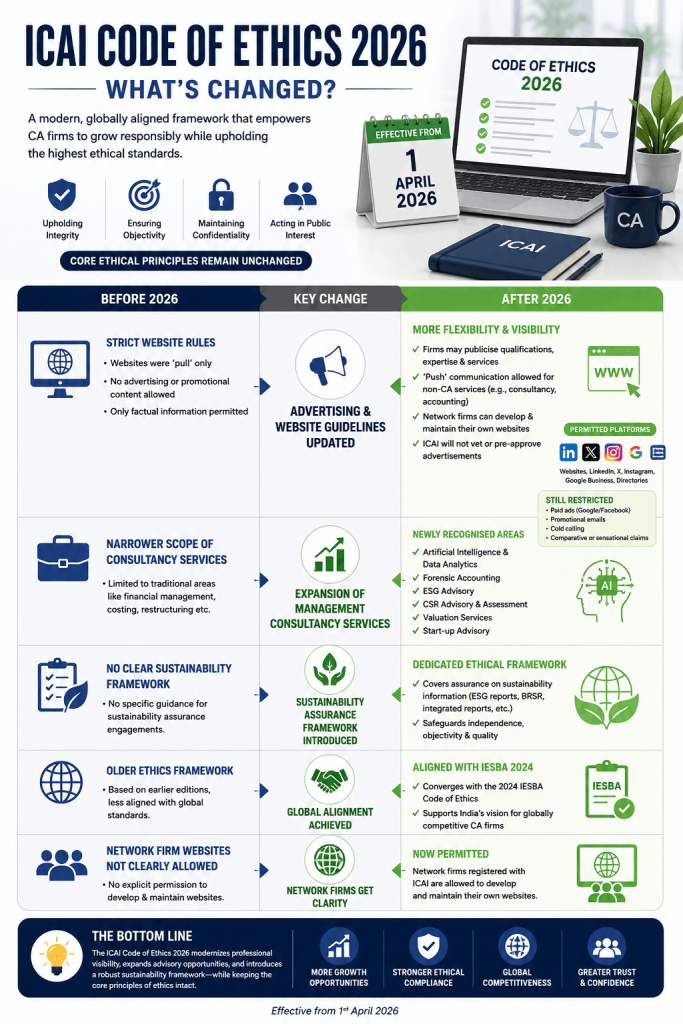
Revised Advertisement and Website Guidelines
This is the change generating the most conversation, and understandably so.
What was allowed earlier
For years, the position was simple and restrictive: no advertising, full stop. CA websites had to be “pull” only – meaning a client had to go looking for you. Websites couldn’t display promotional offers, schemes, or claims about professional achievements, and only factual information relevant to CA professionals was permitted.
What has changed
The 2026 update doesn’t throw the doors wide open, but it does loosen things meaningfully. CA firms may now publicise their qualifications, expertise, and services, as long as communications uphold professional dignity, and ICAI will not vet or pre-approve advertisements.
The key concept to understand here is the difference between “pull” and “push” communication.
Pull information means you create a professional space – a website, a factual social media profile, a directory listing – and interested people find you on their own terms. Push advertising means actively delivering a marketing message to people who didn’t ask for it.
The big shift: the Council has proposed greater flexibility by allowing members and firms to use push technology for services that are not exclusive to the CA profession, such as consultancy and accounting. So if your firm offers, say, business advisory or bookkeeping services alongside core CA work, you have more room to actively promote those specific offerings.
Network firms registered with ICAI also get a notable benefit: they are now permitted to develop and maintain their own websites, which wasn’t clearly allowed before.
What remains restricted
Don’t read this as a green light for full-blown digital marketing campaigns. Paid Google or Facebook ads, promotional email blasts, and cold calling are still considered “push” activities and remain strictly forbidden. Comparative advertising is also still off-limits – you can’t claim to be cheaper or better than other firms, and sensational or fear-based marketing lines like “Notice coming? Act now!” are not acceptable.
Practical examples
What this looks like in practice: a firm can describe itself as “providing tax advisory and business consulting services” or as a “CA firm specialising in GST, income tax and audit.” Permitted platforms include firm websites, LinkedIn, X, professional Instagram pages, Google Business profiles, and professional directories, with allowed content covering service offerings, educational posts, regulatory updates, and credentials presented without exaggeration.
A Google My Business profile is treated as a modern directory listing and is permitted, but it should contain only factual information – firm name, address, phone number, website link, office hours, and a list of services – without soliciting reviews or posting promotional updates.
For most small and mid-sized CA firms, the practical takeaway is this: a clean, informative website and active LinkedIn profile are now clearly within the rules. Paid ads and aggressive outreach are not.
Expansion of Management Consultancy Services (MCS)
Existing scope
CA firms could already offer Management Consultancy and Other Services under Section 2(2)(iv) of the Chartered Accountants Act, 1949. This includes things like financial management advice, costing systems, and helping companies restructure.
Newly recognised service areas
The revised code adds more services to this list. Firms can now formally offer forensic accounting, AI-related services, research analytics, social impact assessment, and a few other emerging areas. One of these was actually allowed earlier than the rest – “Assessment and evaluation of Social Impact, CSR Impact, Business Responsibility and Sustainability Reporting, and the like” became effective from 11th December 2025, a few months before the main 1st April 2026 date.
Impact on CA firms
This is good news for firms already doing this kind of work informally. ESG reporting support, CSR impact evaluation, forensic audits, and tech-driven analytics now have ICAI’s clear approval. If your firm was avoiding marketing these services because they felt like a grey area, that worry is mostly gone now.
Ethics Standards for Sustainability Assurance
What is sustainability assurance
Sustainability assurance is essentially the audit-style verification of a company’s ESG (Environmental, Social, and Governance) disclosures – things like carbon emissions data, CSR spending reports, and Business Responsibility and Sustainability Reports (BRSR) that listed companies in India are increasingly required to file.
Why it matters
The revised code codifies independence provisions for sustainability assurance engagements within Volume III of the Code of Ethics. This means there’s now a formal ethical framework governing how a CA or firm can take on these engagements – particularly around independence, where you can’t provide both consulting and assurance on the same sustainability disclosures for one client.
Opportunities for professionals
With BRSR requirements expanding across Indian listed companies, demand for qualified sustainability assurance providers is only going to grow. CA firms that build capability here early – and can demonstrate they understand the independence rules – are positioning themselves for a genuinely new revenue stream, not just a side project.
Alignment with International Ethical Standards
IESBA convergence
ICAI has converged with the 2024 edition of the IESBA Code of Ethics, the global benchmark used by accounting bodies worldwide. For firms working with multinational clients or international networks, this convergence reduces friction – your ethical framework now speaks the same language as your counterparts abroad.
Independence considerations
New restrictions apply to Non-Assurance Services provided to audit clients, strengthening independence requirements in line with the IESBA framework. In practical terms: if your firm is the statutory auditor for a client, you’ll need to be more careful about what additional non-audit services (tax advisory, consulting, etc.) you take on for that same client, and document how independence is maintained.
What Has Not Changed?
With so much focus on advertising and new service areas, it’s worth pausing on what hasn’t moved an inch. The five fundamental principles that have anchored the Code of Ethics for decades remain exactly as they were:
- Integrity – being straightforward and honest in all professional relationships.
- Objectivity – not letting bias, conflict of interest, or undue influence affect professional judgment.
- Professional competence and due care – maintaining the knowledge and skill needed to provide competent service, and acting diligently.
- Confidentiality – respecting the confidentiality of client information acquired through professional relationships.
- Professional behaviour – complying with relevant laws and avoiding conduct that discredits the profession.
The core principle of not soliciting clients or professional work, directly or indirectly, also remains unchanged – what’s changed is simply how “solicitation” is interpreted in a digital context.
What Do These Changes Mean for CA Firms?
Professional visibility: A factual, well-maintained website and LinkedIn presence are no longer a compliance risk – they’re closer to an expectation. Firms that have avoided building any digital presence out of caution can now do so with more confidence.
Advisory-led growth: With MCS scope formally expanded, firms can lean into advisory work – forensic accounting, CSR impact assessments, AI-related advisory – as genuine practice areas rather than informal add-ons.
ESG opportunities: Sustainability assurance is shaping up to be one of the more significant growth areas for CA firms over the next few years, especially as BRSR compliance widens across Indian companies.
Digital presence: Network firms can now run their own websites, and “push” promotion is allowed for non-exclusive services like consultancy and accounting – giving firms more levers to pull when marketing these specific offerings.
Future-ready practice models: Taken together, these changes nudge the profession toward firms that combine traditional compliance work (audit, tax, GST) with advisory services, digital visibility, and ESG capabilities – a noticeably different practice model than a decade ago.
Key Takeaways for Chartered Accountants
- The revised Code of Ethics (13th Edition) became effective from 1st April 2026, following approval at ICAI’s 447th Council Meeting.
- Advertising is now permitted within strict limits – factual, dignified, non-comparative communication on websites and professional social media.
- Paid digital ads, cold calling, and comparative claims remain firmly prohibited.
- MCS scope has expanded to include forensic accounting, AI-related services, research analytics, and social impact/CSR assessment.
- Sustainability assurance now has a codified independence framework under Volume III.
- The code converges with IESBA 2024, tightening independence rules for non-assurance services to audit clients.
- The five fundamental ethical principles – integrity, objectivity, competence, confidentiality, professional behaviour – are unchanged.
Conclusion
The ICAI Code of Ethics 2026 isn’t a complete overhaul – it’s a recalibration. The profession’s ethical core stays exactly where it’s always been, but the rules around visibility, advisory scope, and emerging services like sustainability assurance have been brought up to date with how business actually works today. For CA firms willing to build out their digital presence thoughtfully and explore the newly recognised advisory areas, this is a meaningful opening provided it’s approached the way the Code intends: factual, dignified, and client-first.