AI in Accounting: How Artificial Intelligence is Transforming Financial Management in India
Businesses in India are no longer treating accounting as just a back-office task. Over the last few years, the way companies handle invoices, GST filing, reconciliations, and financial reporting has changed dramatically. A big reason behind that shift is artificial intelligence.
The conversation around AI In Accounting India is growing because businesses are starting to see practical results, not just hype. Accountants who once spent hours checking spreadsheets manually are now using AI-powered accounting software to automate repetitive work and reduce mistakes.
And honestly, that changes the entire pace of financial management.
Why AI Is Becoming Important in Accounting
Most businesses deal with the same problems:
- Manual data entry
- GST reconciliation issues
- Delayed reports
- Human errors in invoices
- Time wasted on repetitive accounting work
The real issue is not just time. It’s accuracy.
One small mistake in a GST entry or invoice can create unnecessary notices, compliance problems, or cash flow confusion. That’s where AI-based accounting systems are making a noticeable difference.
Instead of relying completely on manual bookkeeping, businesses are using intelligent accounting software that can:
- Read invoices automatically
- Match GST data
- Detect unusual transactions
- Generate reports instantly
- Predict payment trends
This is one reason why AI-powered accounting software is becoming popular among Indian SMEs and CA firms.
How AI Is Changing Financial Management
1. Automated Data Entry
This is probably the biggest relief for accountants.
Earlier, accounting teams had to manually enter sales invoices, purchase bills, and bank transactions into software. It was repetitive and exhausting.
Now AI tools can scan invoices, identify GST numbers, extract amounts, and post entries automatically.
In practical terms, a process that took three hours can now take fifteen minutes.
That’s a major shift for growing businesses handling hundreds of monthly transactions.
2. Smarter GST Reconciliation
GST compliance in India is already complicated enough. Matching purchase data with GSTR-2B manually often creates confusion.
AI accounting tools now compare invoices automatically and highlight mismatches instantly.
Most people ignore this part, but reconciliation errors usually lead to blocked ITC claims or compliance notices later. AI helps reduce that risk significantly.
Many businesses using cloud accounting software are already depending on automated GST reconciliation to avoid last-minute filing stress.
3. Faster Financial Reporting
Business owners no longer want to wait until month-end to understand their finances.
They want quick answers:
- Which expenses are increasing?
- What is the current cash flow status?
- Which customers have outstanding payments?
- Is the business profitable this month?
AI-based financial management systems generate real-time dashboards and reports automatically.
That means business decisions become faster because the numbers are available instantly.
AI Is Helping Chartered Accountants Too
There’s a common misconception that artificial intelligence will replace accountants.
That’s not what’s happening.
AI is removing repetitive work so accountants can focus on advisory services, tax planning, and client management instead.
For example, CA firms handling multiple clients often spend huge amounts of time:
- Collecting documents
- Managing notices
- Tracking pending work
- Following up for invoices
- Checking reconciliations
With automation in accounting, many of these processes are becoming smoother.
Instead of spending time on manual tracking, firms can focus more on consulting and business growth support.
That’s a much more valuable role.
A Real Example: How One CA Firm Stopped Losing Weekends to Reconciliation
This is worth talking about because it shows exactly where the pain sits – and how quickly it can change.
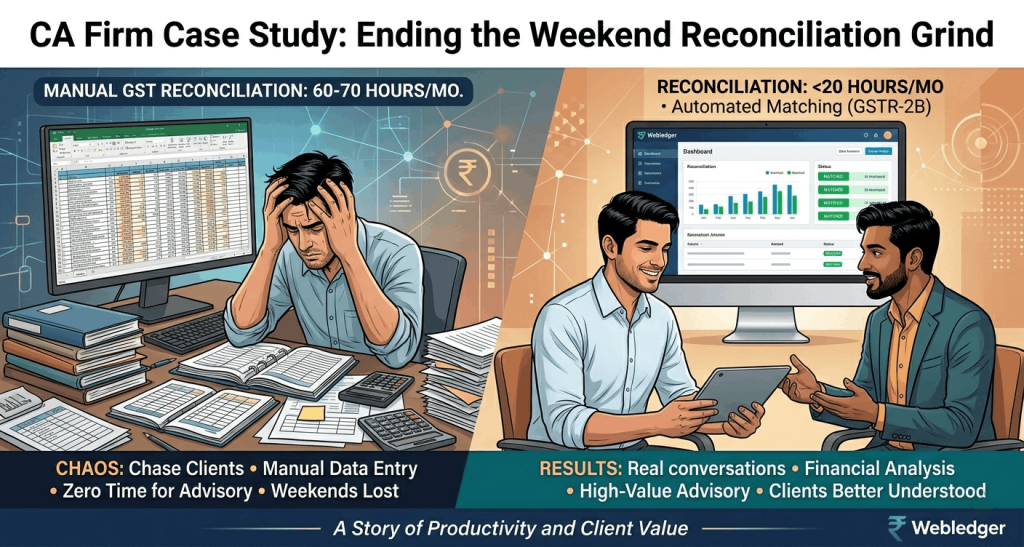
A mid-sized CA firm in Ahmedabad was handling close to 40 clients. Mix of traders, small manufacturers, and a couple of service businesses. The firm had four staff members, and during GST filing season, all four were basically unreachable for anything else. Every month, the same cycle: collect purchase data from clients, manually match it against GSTR-2B, find discrepancies, call the client, wait for clarification, correct entries, then file.
The firm’s senior partner once mentioned that they were spending roughly 60 to 70 hours a month just on reconciliation across all clients. Not on advisory. Not on tax planning. Just on matching numbers that should have been matching in the first place.
They switched to a cloud-based accounting platform – Webledger – that had automated GST reconciliation built in. The system started pulling purchase data and comparing it against GSTR-2B automatically, flagging only the genuine mismatches instead of making the team go line by line.
The first month after switching, reconciliation time dropped to under 20 hours across all 40 clients. The team didn’t have to chase clients for every small clarification because the software was already showing them exactly which invoices were the problem and why.
What changed more than the hours, though, was the nature of the work. The senior partner started spending that recovered time on actual client conversations – reviewing financials, pointing out expense trends, helping one manufacturing client understand why their ITC claims kept getting held up. That client later said it was the first time their CA had actually sat down and explained something beyond just filing numbers.
That’s not a technology success story. That’s what happens when a firm stops spending its best hours on work that software can handle.
Fraud Detection and Error Reduction
One underrated advantage of AI in finance is error detection.
Humans naturally miss things when dealing with repetitive entries every day. AI systems can identify unusual patterns much faster.
For example:
- Duplicate invoices
- Incorrect GST entries
- Unusual payment activity
- Suspicious transactions
- Vendor mismatches
That’s where things usually go wrong in manual accounting systems.
AI tools continuously monitor transactions and flag possible risks before they become bigger problems.
For businesses handling large transaction volumes, this creates an additional layer of financial control.
The Rise of Cloud Accounting in India
AI works even better when combined with cloud accounting software.
Businesses today want access from anywhere. Accountants want client data without repeatedly asking for backups. Owners want reports directly on mobile devices.
Cloud-based accounting platforms make this possible.
Many Indian businesses are now moving away from desktop-only accounting systems because cloud platforms offer:
- Real-time access
- Multi-user collaboration
- Faster updates
- Better security
- Remote accounting management
When AI gets integrated into these systems, financial management becomes far more efficient.
Challenges Businesses Still Face
Of course, not everything is perfect.
Some businesses still hesitate to adopt AI accounting tools because of:
Lack of awareness
Many small business owners still think automation is expensive or complicated.
Resistance to change
Teams comfortable with traditional accounting methods often avoid new systems initially.
Data quality issues
AI tools work best when financial data is clean and organized.
Security concerns
Businesses naturally worry about financial data privacy while using cloud platforms.
Still, adoption is increasing steadily because the operational benefits are becoming difficult to ignore.
What Actually Matters Before Choosing AI Accounting Software
Many businesses focus only on features.
That’s a mistake.
Here’s what actually matters:
Ease of use
If the software feels complicated, teams won’t use it properly.
GST and compliance support
Indian businesses need software built specifically for GST workflows.
Automation quality
Some tools claim automation but still require heavy manual work.
Reporting clarity
Financial reports should be simple enough for business owners to understand quickly.
Support and reliability
When accounting issues happen, fast support matters more than fancy dashboards.
The Future of Accounting in India
The accounting industry in India is clearly moving toward automation and intelligent systems.
Businesses want faster processes. Accountants want efficiency. Clients expect real-time visibility.
That combination is naturally pushing AI adoption forward.
The growth of AI In Accounting India is not just about technology trends anymore. It’s becoming part of everyday business operations.
And realistically, firms that adapt early will probably have a stronger advantage over the next few years.
Key Takeaways
- AI reduces manual accounting work significantly
- Automated GST reconciliation improves accuracy
- Real-time financial reporting helps businesses make faster decisions
- CA firms can focus more on advisory work instead of repetitive tasks
- Cloud accounting and AI are reshaping financial management in India
- Businesses should prioritize usability and compliance support while selecting accounting software